


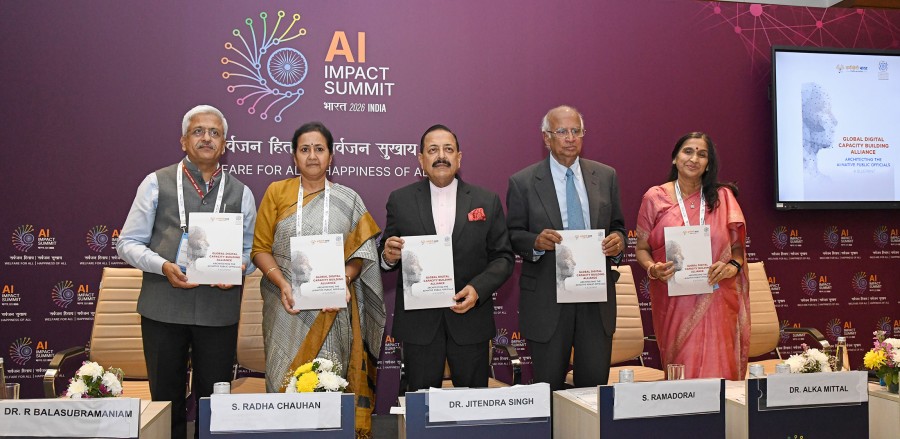
The AI Impact Summit 2026 concluded in New Delhi with the adoption of the New Delhi Declaration on AI Impact, securing the endorsement of 88 countries and international organisations and marking one of the most significant multilateral efforts to shape the global future of artificial intelligence.
Held in the national capital, the summit positioned India at the centre of a growing global consensus that artificial intelligence must be developed and deployed in ways that are collaborative, trusted, resilient and efficient. The declaration articulates a shared vision to harness AI for economic growth and social good, while ensuring that its benefits are equitably distributed.
Anchored in the Indian philosophy of Sarvajan Hitaya, Sarvajan Sukhaya ( welfare for all, happiness for all), the declaration underscores that AI progress must be inclusive and accessible. It calls for strengthened international cooperation, deeper multistakeholder engagement and respect for national sovereignty in shaping AI governance frameworks.
The declaration is structured around seven core pillars, described as chakras of action, that will guide global cooperation. These include democratising AI resources, driving economic growth and social good, building secure and trusted AI systems, advancing AI for science, expanding access for social empowerment, developing human capital, and promoting resilient, efficient and innovative AI infrastructure.
A series of voluntary global initiatives were unveiled at the summit to operationalise these pillars. Among the key deliverables is a Charter for the Democratic Diffusion of AI, aimed at promoting affordable access to foundational AI technologies and fostering locally relevant innovation ecosystems. The Global AI Impact Commons will serve as a collaborative platform to scale and replicate AI use cases across countries, while the Trusted AI Commons will provide tools, benchmarks and best practices to strengthen secure and trustworthy AI development.
Other initiatives include the creation of an International Network of AI for Science Institutions to accelerate cross-border research collaboration, an AI for Social Empowerment Platform to promote equitable adoption, and an AI Workforce Development Playbook accompanied by reskilling principles to prepare economies for AI-led transformation. Guiding principles on resilient and energy-efficient AI systems were also introduced, supported by a playbook on AI infrastructure resilience.
The declaration highlights AI’s expanding role in economic transformation, governance, scientific research and public service delivery. It also stresses the importance of open-source ecosystems and energy-efficient infrastructure as AI adoption scales globally.
Participants reaffirmed their commitment to advancing shared priorities through voluntary, non-binding frameworks and sustained collaboration. With broad international backing, the New Delhi Declaration is expected to catalyse long-term partnerships and reinforce AI’s role as a cornerstone of future economic growth and development.