


In a significant push towards decarbonising India’s freight sector, the Indian Institute of Technology, Madras has unveiled a practical and financially viable roadmap for powering Zero Emission Truck (ZET) charging infrastructure with renewable energy.
The study, along with a comprehensive policy handbook, has been developed by the Centre for Excellence in Energy and Telecommunications (CEET) and the Centre of Excellence for Zero Emission Trucking (CoEZET), both housed in the Department of Engineering Design at IIT Madras. The initiative aims to help policymakers, charge park operators and industry stakeholders accelerate the transition to cleaner freight mobility.
A Blueprint For Green Charge Parks
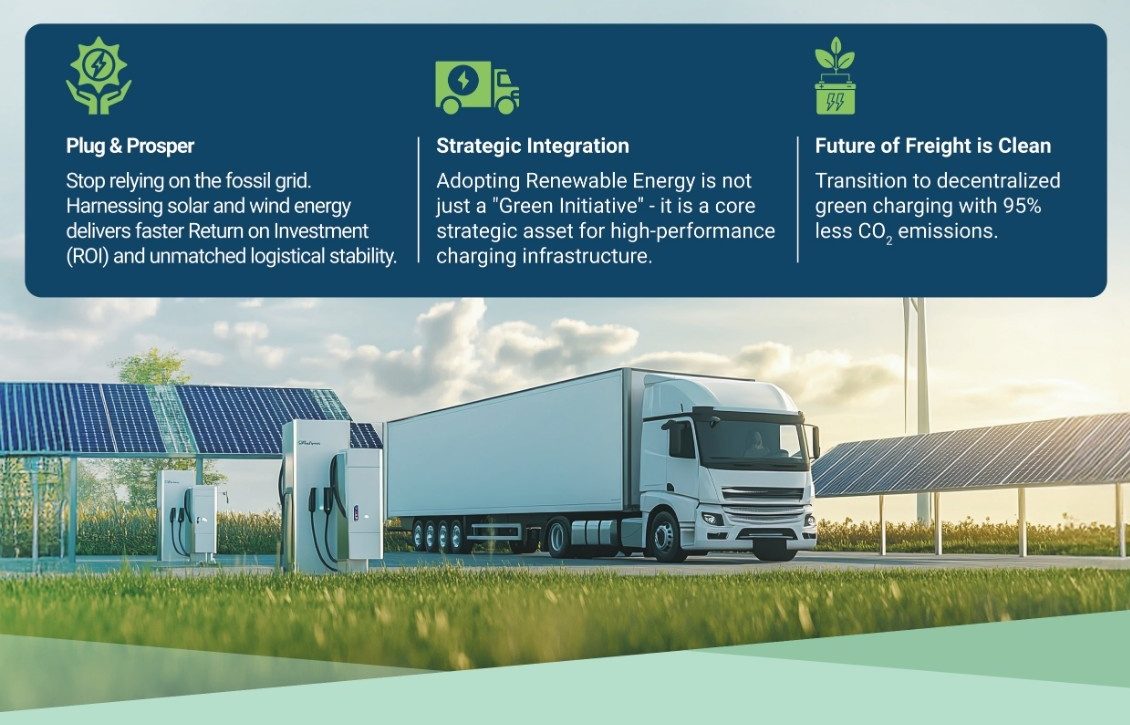
At the heart of the research is a detailed framework for integrating dedicated solar and wind energy generation, supported by Battery Energy Storage Systems (BESS), into high-capacity ZET charge parks. The objective is not merely to electrify trucks, but to ensure that the electricity powering them is also green, thereby reducing dependence on conventional grid power.
As a key outcome, CEET and CoEZET released the “RE-Charge Ready Reckoner – A Handbook on Renewable Energy Integration for Zero Emission Truck Charge Parks.” Designed as a policy-ready reference aligned with state and central government requirements, the handbook provides evidence-based analysis and real-world modelling to strengthen India’s EV charging strategy.
IIT Madras director Prof V Kamakoti emphasised that sustainable decarbonisation of trucking requires parallel greening of the power supply. He noted that the handbook presents a techno-economic framework and viable business mechanisms for establishing renewable energy-integrated ZET charge parks, and is expected to serve as a valuable resource for decision-makers and operators seeking to catalyse green charging infrastructure.
Targeting A High-Impact Sector
The urgency of the transition is underscored by the structure of India’s logistics sector. According to CoEZET principal investigator Prof C S. Shankar Ram, road transport handles nearly 65% of the country’s freight and contributes close to 5% of GDP. Yet, trucks, representing just about 3% of vehicles, account for an estimated 53% of on-road particulate matter pollution. Transitioning this segment to zero-emission trucking, he noted, offers disproportionately high benefits for air quality, public health and energy security.
What sets the study apart is its corridor-based approach focused specifically on heavy-duty ZET charging powered by renewables. Researchers analysed two major freight corridors, Chennai–Bangalore and Solapur–Vijayapura, combining traffic data, techno-economic modelling, policy analysis and power electronics design to create site-specific, scalable solutions.
Financial Viability At The Core
The handbook addresses key commercial concerns such as upfront investment, operating expenses and long-term returns. It demonstrates how renewable energy combined with BESS can lower energy costs and demand charges, while transforming ZET charge parks into future-ready multi-energy hubs.