


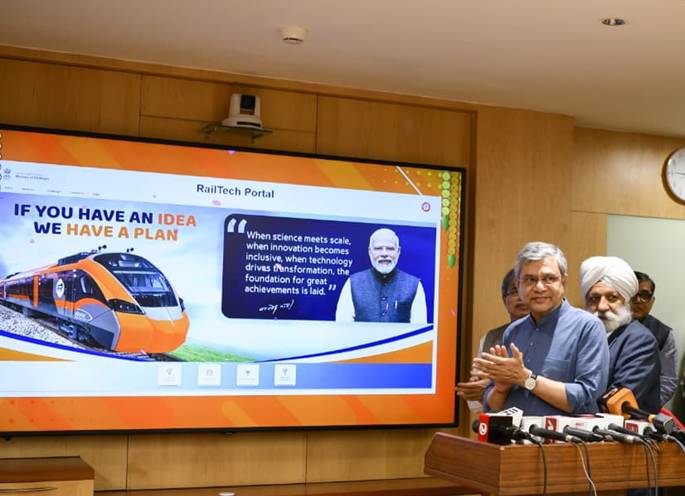
In a major push to modernise one of the world’s largest rail networks, Indian Railways has unveiled a new Rail Tech Policy and a dedicated RailTech Portal designed to bring startups, innovators, researchers and industry closer to the country’s rail ecosystem.
The initiative marks a shift in how technology is inducted into the Railways, moving away from rigid vendor specifications towards a structured, innovation-driven framework that encourages experimentation, pilot testing and large-scale adoption.
A Digital Gateway For Innovation
At the core of the reform is the RailTech Portal, a completely digital, end-to-end platform that allows anyone with a strong technological idea to directly approach the Railways. Innovation challenges can now be initiated either by departmental users or external innovators, with a simplified single-stage detailed proposal submission process.
The objective is clear: make innovation accessible, transparent and scalable. By streamlining procedures and removing bureaucratic bottlenecks, the Railways aims to create a systematic pathway for cutting-edge technologies to move from concept to deployment across the vast national network.
Union Minister for Railways Ashwini Vaishnaw said the policy has been crafted to enable “massive and systematic induction of technology” into the Railways. He emphasised that innovators must be able to engage with the Railways in a structured and meaningful manner, through a simplified and digitally driven interface.
Learning From Proven Models
The Rail Tech Policy has drawn inspiration from successful innovation ecosystems such as the defence sector’s iDEX initiative and startup frameworks in electronics and telecom. By studying these models, the Railways has sought to design a transparent and innovation-friendly architecture that, if successful, could serve as a template for other sectors.
A key highlight is the enhanced funding support. The scale-up grant has been increased more than threefold, while the maximum grant for prototype development and trials has been doubled. Under the policy, the Railways will support up to 50% of development costs for viable technological solutions. Once proven, successful projects will be backed by substantial long-term orders to ensure full-scale implementation. The intent is not merely to pilot ideas, but to embed them into mainstream operations.
From AI to Drones: Wide-Ranging Applications
The scope of innovation envisioned is expansive. Among the focus areas are AI-based Elephant Intrusion Detection Systems to prevent wildlife accidents, AI-enabled fire detection in coaches, drone-based broken rail detection, rail stress monitoring systems and obstruction detection technologies for foggy conditions.
Other potential applications include AI-powered CCTV systems to strengthen passenger security, predictive monitoring of overhead electrical parameters to foresee failures, infrared and ultrasonic-based track inspection systems, and drone-enabled analytics to detect overheating insulators or structural fractures.
Technology is also expected to transform administrative processes. AI-based pension processing and dispute resolution systems could ensure faster clearance of retirement benefits for railway employees, demonstrating that innovation will extend beyond tracks and trains to governance and service delivery.
Building An Innovation Ecosystem
The Rail Tech Policy signals a broader philosophical shift within Indian Railways — from being a traditional public transporter to becoming a technology-driven infrastructure platform. By inviting startups, institutions and industry players into its operational core, the Railways is positioning itself as an open innovation ecosystem. For India’s startup community, the message is equally clear: the Railways is open for ideas, and ready to scale them.