


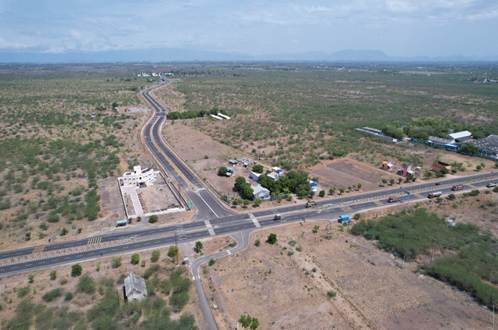
Tamil Nadu’s textile ambitions received a major push this week as the Board of Directors of PM Mitra Park Tamil Nadu Ltd cleared the allotment of 190.44 acres to 23 investors, unlocking a committed investment pipeline of ₹2,192.21 crore and a potential to generate 15,000 jobs.
The decision, taken at the ninth board meeting chaired by Neelam Shami Rao, Secretary, Ministry of Textiles, marks a transition point for the PM Mitra Park at Virudhunagar, from master planning and infrastructure rollout to tangible industrial occupation.
A Full-Stack Textile Play
Unlike conventional industrial parks, the PM Mitra (Mega Integrated Textile Region and Apparel) framework is designed around vertical integration. The approved investments at Virudhunagar reflect that design philosophy: integrated plants, yarn manufacturing, fabric production, processing and finishing, garment manufacturing and technical textiles.
This layered investment structure is significant. Tamil Nadu is already a dominant textile and apparel exporter, but the value chain has historically been fragmented across clusters. By co-locating spinning, weaving, processing and garmenting units within a single ecosystem, the Park aims to compress lead times, reduce logistics costs and improve cost competitiveness, critical factors in a global market increasingly driven by speed-to-market and sustainability compliance.
Infrastructure As A Strategic Differentiator
The Park’s competitive pitch rests not only on scale but on infrastructure depth.
With a project cost of ₹1,894 crore, the Virudhunagar Park is being built with:
- A 15 MLD CETP with Zero Liquid Discharge (ZLD) capability
- A 20 MW solar power plant
- Centralised steam boilers
- Nearly 13 lakh sq. ft. of plug-and-play units
Additionally, ₹550crore worth of infrastructure works are already under execution in and around the site, signalling execution momentum rather than intent on paper.
Water sustainability has emerged as a defining issue for textile processing, particularly in dyeing and finishing operations. The proposed large-scale ZLD facility, backed by 20 MLD capacity planning, positions the Park as compliance-ready in an era where ESG audits and environmental certifications increasingly influence global sourcing decisions.
For small and medium processing units, access to centralised ZLD can significantly lower capital burden, enabling participation in export-oriented supply chains without duplicating costly effluent infrastructure.
Location Economics and Logistics Edge
Strategically located on NH 44 and about 106 km from Tuticorin port, the Park integrates road-port connectivity with access to Tamil Nadu’s mature textile ecosystem. The geography matters: export logistics efficiency is often the difference between margin erosion and margin protection in apparel exports.
By anchoring the Park close to established textile belts, the model reduces migration friction for skilled labour while allowing existing manufacturers to expand capacity within a formalised, policy-supported zone.
Policy Alignment And Governance Model
The Board’s emphasis on transparent, policy-aligned and ecosystem-driven development reflects an effort to differentiate PM Mitra parks from earlier industrial zone experiments. Structured as a Special Purpose Vehicle (SPV), the governance framework brings together the Ministry of Textiles, the Government of Tamil Nadu, SIPCOT and institutional partners like NICDC.
This blended Centre-State ownership architecture is intended to ensure policy continuity, faster approvals and coordinated infrastructure build-out, key concerns for large-scale textile investors.
The Virudhunagar Park is one of seven mega parks being developed under the national PM MITRA scheme, which seeks to create globally competitive textile clusters capable of anchoring India’s ambitions in technical textiles, man-made fibres and high-value garment exports.
What the Allotment Really Signals
The allocation of 190 acres in a single board cycle is more than a land transaction—it is an early test of investor appetite under the integrated cluster model.
Three indicators stand out:
- Diversity of segments suggests risk dispersion across the value chain rather than concentration in spinning alone.
- Investment size indicates mid-to-large scale industrial commitments rather than speculative land holding.
- Job intensity—15,000 projected roles—aligns with the labour-intensive character of downstream garmenting and processing units.
With the Park targeted for completion by December 2027, the coming 18–24 months will determine whether infrastructure timelines match investor commissioning schedules, a critical factor in sustaining confidence.
If execution remains on track, Virudhunagar could evolve from a regional textile stronghold into a nationally benchmarked integrated manufacturing cluster, one designed not just for volume but for sustainability, scale and global competitiveness.