


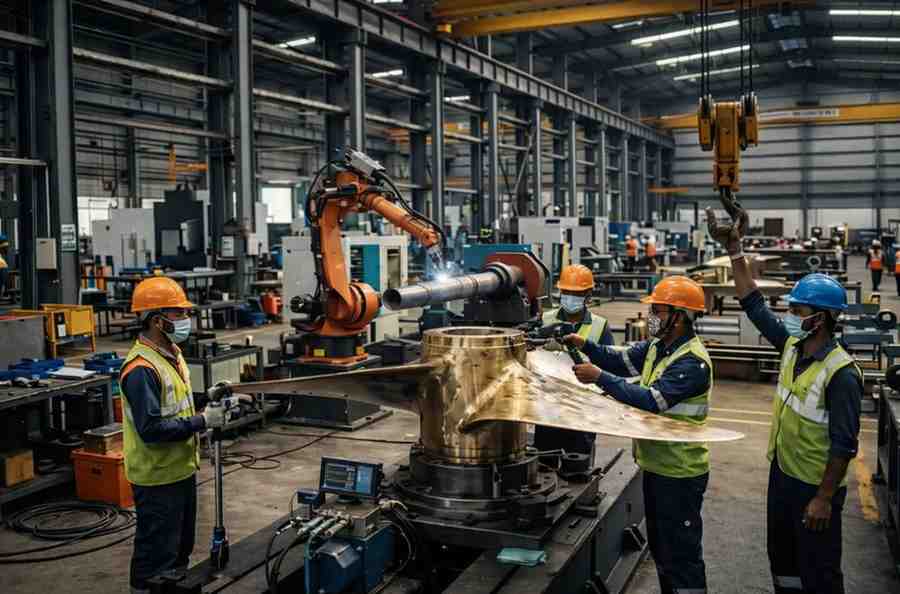
The Tamil Nadu government’s new Shipbuilding Policy signals an ambitious intent: from being a manufacturing powerhouse to positioning itself as India’s primary hub for large-scale, sustainable and technologically advanced shipbuilding.
At its core, the policy is not just about attracting shipyards, it is about building a maritime ecosystem that integrates design, fabrication, repair, R&D and training into dedicated clusters, backed by targeted incentives and state-supported financing mechanisms.
A Shift From Ports To Platforms
Tamil Nadu already has a long coastline and an industrial base, but this policy seeks to convert geographic advantage into strategic dominance. Covering vessels from large ocean-going ships and specialized vessels to defence crafts, luxury yachts, submarines and mechanised fishing boats (excluding trawlers and FRP boats), the policy casts a wide net across commercial, defence and niche maritime segments.
The explicit ambition to attract high-value vessels, including Very Large Crude Carriers (VLCCs). is particularly notable. Such vessels typically require deep drafts, stable geological foundations and long uninterrupted construction windows, areas where the state believes it has natural advantages.
Geography As Competitive Capital
Tamil Nadu’s coastline, stretching from Tiruvallur to Kanniyakumari and accounting for 9.63% of India’s total coastline, offers natural deepwater access and favourable bathymetric conditions suitable for vessels exceeding 2,00,000 DWT. Reduced dredging needs could lower both capital expenditure and environmental impact, an important selling point in a sector increasingly scrutinised for ESG compliance.
Operationally, the state’s rainfall pattern, concentrated largely in the Northeast Monsoon between October and December, offers extended dry periods conducive to uninterrupted construction. Compared to India’s western coast, which faces prolonged monsoon disruptions, this climatic pattern could translate into shorter build cycles and improved cost efficiency.
The SPV Model: De-Risking Investment
A standout feature of the policy is the creation of a Special Purpose Vehicle (SPV), NSHIPTN, under SIPCOT. The SPV is designed to serve as a single-window enabler, developing landside and seaside infrastructure, entering joint ventures, leasing critical assets and facilitating capital raising.
More strategically, the state is prepared to become a minority equity stakeholder, up to 49%, in qualifying projects. Equity support would initially be extended as milestone-linked debt, later convertible into equity upon achievement of defined benchmarks. This structured participation mechanism effectively reduces project risk for investors while ensuring accountability and phased capital infusion.
This approach reflects a broader trend in industrial policy where states are no longer just facilitators but active financial participants in high-capex sectors.
Scale Thresholds And Structured Assistance
To qualify for the Structured Package of Assistance (SPA), shipyards must commit a minimum investment of ₹1,000 crore and generate at least 1,000 jobs. By setting high entry thresholds, the government is clearly targeting globally competitive, large-scale players rather than fragmented or low-capacity operations.
This aligns with Tamil Nadu’s broader industrial identity, home to over 40,000 factories and a leader in electronics exports with over 41% national share in 2024–25. The state’s experience in cluster-led development (automotive, electronics, textiles) is now being extended to shipbuilding.
ESG And Industry 4.0 At The Core
Unlike traditional maritime policies focused primarily on incentives, this framework integrates sustainability and digital transformation as central pillars. The emphasis on ESG compliance, green innovation, circular economy practices and Industry 4.0 integration signals alignment with global maritime trends, where decarbonisation, smart yards and automation are becoming competitive differentiators.
If effectively implemented, Tamil Nadu could position itself not just as a low-cost manufacturing base but as a next-generation maritime technology hub.
Strategic Implications
India’s shipbuilding sector has historically lagged global leaders such as South Korea and China in scale and export competitiveness. Tamil Nadu’s policy, valid for five years and subject to periodic revision, appears designed to capture part of this gap, especially as global supply chains diversify and defence shipbuilding gains prominence.
The success of the initiative will hinge on three critical factors:
- Speed of infrastructure rollout under the SPV model
- Ability to attract anchor global shipbuilders
- Coordination with Central government support for seaside facilities and regulatory clearances
If these align, the policy could catalyse a new maritime industrial cluster, leveraging geography, financial engineering and sustainability mandates to create long-term competitive advantage.
In effect, Tamil Nadu is not merely inviting shipyards; it is attempting to architect an integrated maritime ecosystem. Whether it succeeds will depend less on the policy’s ambition and more on execution discipline, something the state has demonstrated in other industrial sectors.