


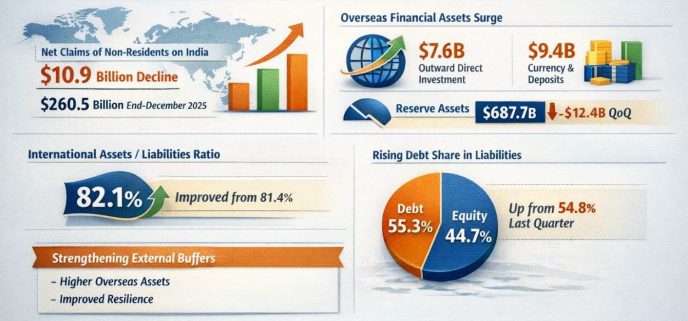
India’s external balance sheet strengthened in the third quarter of FY26, with net claims of non-residents declining sharply, reflecting a faster expansion in overseas assets held by residents compared to foreign investments into the country.
Net IIP improves on faster asset accumulation
According to the Reserve Bank of India’s data on India’s International Investment Position (IIP), net claims of non-residents on India declined by $10.9 billion between end-September and end-December 2025, to $260.5 billion.
This improvement was primarily driven by a higher increase in Indian residents’ overseas financial assets, which rose by $12.8 billion during the quarter, compared to a relatively modest rise of $1.9 billion in foreign-owned assets in India.
Reflecting this shift, the ratio of India’s international assets to liabilities improved further to 82.1% at end-December 2025, up from 81.4% in the previous quarter and 74.6% a year earlier—indicating a steady strengthening of the country’s external balance sheet.
Outward investments and deposits drive asset growth
The increase in overseas financial assets was led by robust growth in outward direct investments, which rose by $7.6 billion, and currency and deposits, which surged by $9.4 billion.
However, reserve assets, accounting for a dominant 57.4% share of total overseas assets, declined by $12.4 billion sequentially to $687.7 billion as of end-December 2025. On a year-on-year basis, though, reserve assets registered a healthy growth of 8.2%, indicating underlying resilience.
Liability-side dynamics signal shift towards debt
On the liabilities side, a decline in inward direct investment ($3.2 billion) and portfolio investment ($2.8 billion) was largely offset by a sharp increase in trade credit ($11.4 billion) under the ‘other investment’ category. This resulted in a marginal sequential increase of 0.1% in foreign-owned assets in India.
Notably, the composition of external liabilities is witnessing a gradual shift. With a decline in equity inflows and a rise in debt components, the share of debt liabilities increased to 55.3% at end-December 2025, up from 54.8% in the previous quarter.
Improving buffer, but rising debt mix warrants watch
The latest IIP data underlines a positive trend in India’s external sector, with stronger overseas asset accumulation helping reduce net external liabilities and improve key ratios. This suggests enhanced resilience against external shocks.
However, the rising share of debt in total external liabilities indicates a subtle shift in capital flow composition, from equity-led to debt-driven inflows, which could increase sensitivity to global interest rate cycles and capital flow volatility.
Going ahead, sustaining the momentum in outward investments while ensuring stable equity inflows will be critical to maintaining a balanced and resilient external position.