


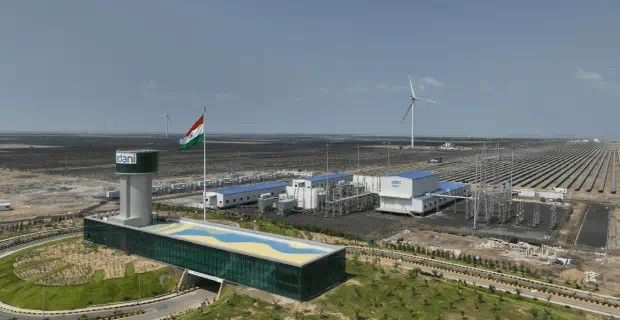
Adani Green Energy Ltd (AGEL), India’s largest pure-play renewable energy company, added over 5 GW (5,051 MW) of renewable energy capacity in FY26, taking its total operational portfolio to 19.3 gigawatts (GW).
This marks the highest annual greenfield capacity expansion globally by any company, excluding China.
Balanced renewable Mix
The newly added capacity comprises 3.4 GW (3,409 MW) of solar, 0.7 GW (686 MW) of wind, and 1 GW (956 MW) of wind-solar hybrid capacity, reflecting a diversified and integrated renewable energy strategy.
Significant carbon offset impact
The new installations are expected to offset nearly 10 million tonnes of carbon emissions annually. With a total operational capacity of 19.3 GW, AGEL’s portfolio is projected to deliver an annual carbon offset of approximately 36 million tonnes.
Khavda mega project drives growth
A majority of the new capacity was commissioned at AGEL’s flagship renewable energy project in Khavda, Gujarat, set to become the world’s largest renewable energy plant.
Spanning 538 square kilometers, nearly five times the size of Paris, the project is being developed at an accelerated pace on barren land. Of the planned 30 GW capacity by 2029 at Khavda, AGEL has already operationalised 9.4 GW (9,413 MW).
Watershed moment for India’s renewable energy sector
AGEL executive director Sagar Adani said: “Our addition of over 5 GW of new capacity marks a watershed moment for India’s renewable energy sector, placing the country firmly on the global map of clean energy leadership. It represents a significant leap in accelerating the transition to a low-carbon economy and strengthening energy security. This milestone reinforces our progress towards achieving 50 GW capacity by 2030, while continuing to deliver sustainable and inclusive growth through renewables and energy storage solutions.”
Battery storage milestone
The company also commissioned an initial 1,376 megawatt-hours (MWh) of battery energy storage systems (BESS) at Khavda, one of the world’s largest single-location deployments of its kind.
Notably, this capacity was installed within just eight months of commencing work, enhancing grid stability and facilitating renewable energy integration.
Advanced technology deployment
The Khavda project incorporates cutting-edge technologies, including bifacial solar modules that generate power from both direct sunlight and ground reflections, along with solar trackers to optimise energy output.
It also features 5.2 MW wind turbines, among the most powerful onshore units globally. Additionally, the deployment of waterless robotic cleaning systems ensures near-zero water usage for module maintenance while improving operational efficiency.