


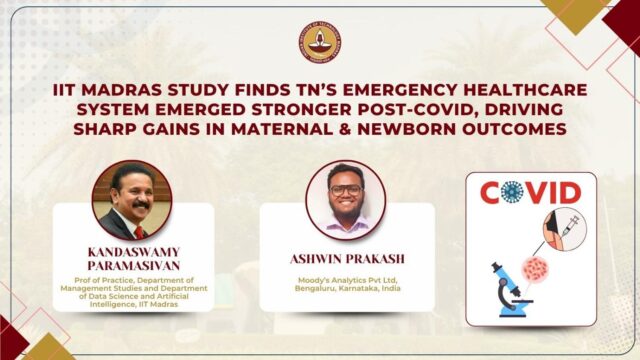
Researchers from Indian Institute of Technology Madras have found that sustained investments in emergency medical services (EMS) and maternal healthcare helped Tamil Nadu not only recover from the disruptions caused by the COVID-19 pandemic but also significantly improve maternal and newborn health outcomes in the post-pandemic period.
The study analysed eight years of ambulance registry data from Tamil Nadu’s 108 emergency response system between 2017 and 2024, covering 42 districts and a population of over 84 million. The findings were published in BMC Pregnancy and Childbirth.
Pandemic disruptions and recovery
The research was led by P Kandaswamy, a retired IPS officer, who is currently a professor of practice in the Departments of Management Studies and Data Science and AI, IIT Madras, along with Ashwin Prakash, Moody’s Analytics Pvt Ltd, Bengaluru. The study examined how Tamil Nadu’s healthcare system functioned through multiple phases of the pandemic and the recovery period during 2023–2024.
According to Prof. Kandaswamy, Tamil Nadu witnessed severe disruptions in maternal healthcare access during the second wave of COVID-19. Pregnant women struggled to reach hospitals, home deliveries increased sharply and maternal mortality rose nearly 98.5% compared to pre-pandemic levels.
However, the study found that EMS performance indicators such as ambulance response time, patient transfer time and hospital handoff time improved significantly after the first wave and remained efficient through 2024.
Maternal and neonatal indicators improve
The researchers noted that maternal and newborn health outcomes in the resilient recovery phase outperformed pre-pandemic levels.
Co-author Ashwin Prakash said maternal mortality declined 19% to 37 deaths per 100,000 live births, significantly below the national average. Home deliveries dropped by over 36%, miscarriages declined by 28% and complicated vaginal births reduced by more than 19%.
The study also found neonatal mortality and infant mortality fell by 17% and 19% respectively during the post-pandemic phase.
Tamil Nadu model offers blueprint
The researchers attributed the improvements to sustained government investments in ambulance infrastructure, expansion of the healthcare workforce and targeted maternal healthcare programmes.
The study highlighted Tamil Nadu’s integrated healthcare model, including the 108 ambulance network and risk-stratified antenatal care programmes, as a potential blueprint for other Indian states with weaker emergency response systems and higher maternal mortality rates.
The researchers also said the study was unique in breaking the pandemic into eight distinct phases, allowing a more detailed analysis of how healthcare delivery evolved during and after the crisis.
At the same time, the team cautioned that the findings establish strong associations between EMS improvements and better maternal outcomes, but do not prove direct causation.