


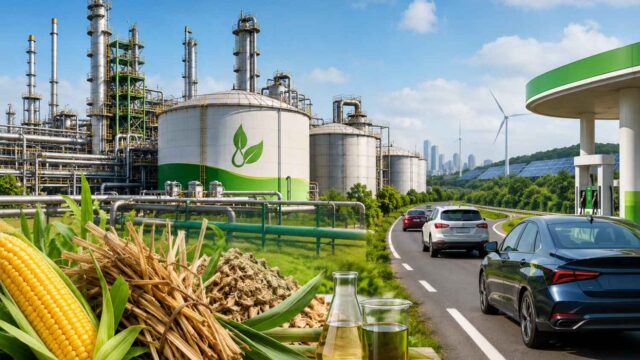
India has achieved 20% ethanol blending in petrol under the Ethanol Blended Petrol (EBP) Programme in 2025-26, reaching the target five years ahead of schedule and marking a major milestone in the country’s clean energy and energy security roadmap.
The programme, which has emerged as a key pillar of India’s biofuel strategy, has significantly reduced dependence on imported crude oil, strengthened farmers’ incomes and lowered greenhouse gas emissions by promoting the use of domestically produced renewable fuel.
Blending rises sharply
Ethanol blending in petrol has increased from less than 1.5% in 2013-14 to 20% in 2025-26. During the same period, ethanol procurement has grown from about 38 crore litres in the Ethanol Supply Year (ESY) 2013-14 to a projected 1,200 crore litres in ESY 2025-26.
India’s ethanol production capacity has also expanded nearly fivefold, rising from 421 crore litres in 2014 to around 2,000 crore litres in 2026, enabling the country to meet the growing demand for blended fuel.
The expansion has helped reduce crude oil imports, conserve foreign exchange and create additional market opportunities for farmers producing sugarcane, maize and rice.
Reducing dependence on imported oil
India imports nearly 88.5% of the crude oil it consumes, making the country vulnerable to global price volatility and supply disruptions.
The government said ethanol produced from domestic agricultural feedstocks offers a sustainable alternative by replacing a portion of imported fossil fuels with renewable fuel produced within the country.
Auto industry backs E20 fuel
Leading automobile manufacturers have expressed confidence in the safety and performance of E20 fuel, citing extensive testing and real-world service data.
Toyota Kirloskar Motor Country Head and Executive Vice President Vikram Gulati said ethanol has been used globally for decades and that the decision to adopt E20 followed rigorous testing, including evaluations on older vehicles.
Maruti Suzuki Senior Executive Officer (Corporate Affairs) Rahul Bharti said the company serviced 2.84 crore vehicles during FY2025-26, including more than 1.5 crore vehicles that were over three years old and not E20-certified, without finding any E20-related damage.
He added that the impact on fuel efficiency is marginal, estimating a reduction of about 0.6 km per litre for a vehicle delivering 20 km per litre, while factors such as driving habits and vehicle maintenance have a much greater influence on mileage.
Hero MotoCorp Chief Business Officer Ashutosh Varma said analysis of extensive service records found no higher incidence of damage in vehicles operating on E20 compared with earlier fuel blends.
Former Engineers India Limited Chairman and Managing Director Vartika Shukla said the ethanol blending programme was developed through extensive stakeholder consultations and is supported by scientific evidence, rigorous automotive testing and global best practices.
She noted that E20 fuel complies with BIS standards and BS-VI emission norms and is now available across retail fuel outlets nationwide.
Ethanol blending gains global acceptance
The government said ethanol blending has become a widely adopted strategy across major economies.
The United States uses E10 as its standard petrol blend, while E15 is being expanded with government support. Millions of flex-fuel vehicles in the country can operate on blends up to E85.
Brazil, one of the world’s leading ethanol producers, currently mandates E27 petrol and is moving towards a blend of around 35%. More than 80% of new vehicles sold there are flex-fuel models capable of operating on higher ethanol blends or pure hydrous ethanol.
Japan has also introduced ethanol into its fuel mix through a phased rollout of E10, while countries such as Canada, Thailand and several European nations have incorporated ethanol blending into their clean fuel strategies.
Strengthening India’s energy transition
The government said the Ethanol Blended Petrol Programme has evolved into a cornerstone of India’s energy transition through scientific evaluation, phased implementation and collaboration between government, industry and research institutions.
Besides improving energy security, the programme has reduced emissions, lowered crude oil imports and created new income opportunities for farmers, while contributing to a cleaner, more resilient and self-reliant transport fuel ecosystem.