


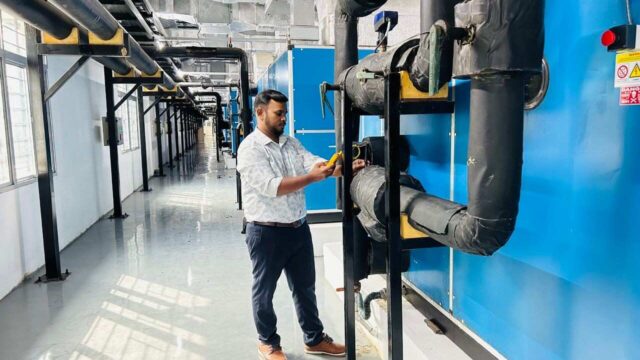
Kotak Mahindra Bank’s flagship sustainability initiative, the Kotak IIT Madras Save Energy Mission (KISEM), has emerged as one of India’s largest bank-funded industrial decarbonisation programmes, helping Micro, Small and Medium Enterprises (MSMEs) save ₹96 crore annually while cutting greenhouse gas emissions by more than 1.23 lakh metric tonnes every year.
The achievement comes one year after the launch of Phase 3 of the programme, which expanded the initiative’s footprint through three new centres at IIT Kanpur, IIT Jodhpur and IIT Kharagpur. The latest expansion has transformed KISEM into a pan-India network comprising ten IIT-linked energy assessment centres focused on industrial energy efficiency and MSME decarbonisation.
Over 500 energy audits completed
Launched in September 2022 under Kotak Mahindra Bank’s CSR-led Environment and Sustainable Development programme, KISEM has completed more than 509 energy audits across 30 industrial sectors.
The initiative has generated 5,850 energy-saving recommendations for participating industries. According to programme estimates, full implementation of these recommendations could unlock an additional ₹404 crore in annual cost savings for MSMEs.
The programme’s growing impact comes at a time when India is intensifying efforts to improve industrial energy efficiency and accelerate the transition towards low-carbon manufacturing.
National expansion strengthens footprint
KISEM traces its origins to the Industrial Energy Audit Cell established at IIT Madras in 2018. What began as a regional energy assessment initiative has evolved into a nationwide collaborative platform involving ten Indian Institutes of Technology.
The hub-and-spoke model is anchored by IIT Madras and includes participation from IIT Bombay, IIT Indore, IIT Gandhinagar, IIT Ropar, IIT Guwahati, IIT Hyderabad, IIT Kanpur, IIT Jodhpur and IIT Kharagpur.
The programme has steadily expanded through multiple phases, adding digital energy audit capabilities, scaling industrial assessments and broadening its geographic reach.
Regulatory milestone boosts credibility
A key milestone for the initiative is the empanelment of all seven existing KISEM centres under the Bureau of Energy Efficiency’s ADEETIE scheme.
The empanelment enables KISEM auditors to undertake government-accredited investment-grade energy audits, allowing MSMEs to use audit findings for capital expenditure decisions and energy-efficiency investments.
The programme currently has two BEE Accredited Energy Auditors and eleven Certified Energy Auditors within its network.
Focus on MSME competitiveness
Kotak Mahindra Bank, Head – SME, Shekhar Bhandari, said, “Through KISEM, we are investing in India’s industrial backbone — the MSME sector. Having completed over 500 energy audits across 30 sectors, delivering over INR 96 crore in annual savings and reducing more than 1.23 lakh tonnes of CO₂ emissions each year, by expanding to Phase 3, Kotak reinforces its commitment to science-led climate action and India’s low-carbon development strategy, while enhancing the cost-competitiveness of small and medium enterprises.”
Driving systemic change
The bank believes industrial decarbonisation must extend beyond large corporations and include millions of MSMEs that remain outside formal sustainability frameworks.
Kotak Mahindra Bank, Head – CSR & ESG, Himanshu Nivsarkar, said, “India’s industrial decarbonization challenge will be shaped not only by large corporates, but by millions of manufacturing MSMEs that remain outside formal climate and regulatory frameworks. KISEM was conceived as a first-of-its-kind, multi-IIT collaboration to bring these MSMEs into the Net Zero conversation through scientific rigor, practical implementation and scalable energy-efficiency solutions.”
Expanding beyond MSMEs
KISEM, National Coordinator, Satyanarayanan Seshadri, said, “From this financial year, we have expanded our focus to include commercial audits for large-scale industries and MNCs. Our three-phase net-zero approach, from baseline through to sustained implementation, mirrors what institutional sustainability teams need.”
According to Seshadri, the programme recently completed a nationwide sustainability assignment covering 24 dairy manufacturing facilities of an agro-products company.
Building a national decarbonisation platform
KISEM’s rapid growth highlights the increasing role of public-private-academic partnerships in helping Indian industries improve energy efficiency and reduce emissions.
KISEM, National Co-coordinator, Prof. Mahesh Panchagnula, said, “In just one year since these centres became operational, the KISEM network has collectively crossed 500-plus industrial audits, demonstrating the scalability and national relevance of this model.”
With ten IIT centres now operational and regulatory recognition under BEE’s ADEETIE framework, KISEM is positioning itself as a national platform supporting industrial decarbonisation, energy efficiency and MSME competitiveness.