


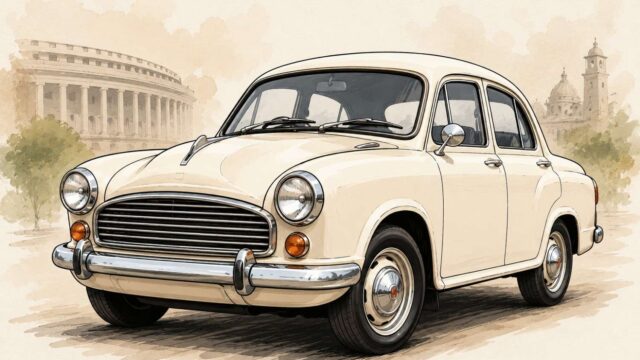
For decades, the Ambassador was more than just a car. It was a symbol of power, authority and prestige. From politicians and bureaucrats to industrialists and diplomats, the iconic sedan occupied a unique place in India’s social and political landscape.
Manufactured by Hindustan Motors, the Ambassador dominated Indian roads for generations and became one of the country’s most recognisable automotive brands.
More than a decade after production ceased, however, Hindustan Motors finds itself at a crossroads. The company that once defined Indian motoring is now focused on preserving value, unlocking assets and identifying new business opportunities amid a dramatically changed industrial landscape.
Looking beyond Uttarpara
In its stock exchange disclosure on May 28, 2026, Hindustan Motors indicated that it is actively exploring new avenues of business and seeking strategic business and technology partners to capitalise on assets outside West Bengal.
The development comes at a crucial juncture for the company following a major setback involving its historic Uttarpara manufacturing facility.
During FY26, the West Bengal government resumed possession of land associated with the Uttarpara factory. As a result, Hindustan Motors wrote off the related property, plant and equipment in its books and reported the impact as an exceptional item in its financial statements.
Despite the setback, the company has not given up its legal battle. It plans to file a review petition seeking reconsideration of its claim for a portion of the land under Section 6(1)(c) of the West Bengal Estates Acquisition Act, 1953.
According to the company, the retained industrial land could still be developed to promote engineering and ancillary manufacturing activities in the state.
Financial health shows improvement
While Hindustan Motors no longer manufactures passenger vehicles, its balance sheet tells a story of gradual financial recovery. The company’s accumulated losses declined significantly to ₹100 crore as of March 31, 2026, compared with ₹252 crore in 2017.
Its net worth improved to ₹31 crore in FY26, up from ₹24 crore in FY25 and a negative ₹16 crore in FY23, reflecting a steady strengthening of its financial position.
Importantly, Hindustan Motors is now largely debt-free from a financial debt perspective, with only limited employee-related and other liabilities remaining.
The company also reported that current assets exceed current liabilities, resulting in a favourable liquidity position. Management continues to prepare its financial statements on a going-concern basis, signalling confidence in the company’s ability to continue operations.
The Ambassador brand is no longer its own
One of the biggest misconceptions surrounding Hindustan Motors is that it still owns the iconic Ambassador brand. That changed in 2017 when the company sold the Ambassador brand, trademarks and associated intellectual property rights to French automaker Peugeot for approximately ₹80 crore.
The transaction effectively ended Hindustan Motors’ ownership of one of India’s most celebrated automotive nameplates. As a result, the company no longer possesses the rights to independently manufacture or relaunch the Ambassador.
Although rumours of a revival continue to surface periodically, no commercial programme for the return of the Ambassador has been announced.
The rise and fall of Uttarpara
No discussion about Hindustan Motors is complete without mentioning the legendary Uttarpara plant. Established in the 1940s, the facility became one of Asia’s oldest automobile manufacturing plants and served as the birthplace of generations of Ambassador cars.
At its peak, the plant employed thousands of workers and stood as a symbol of India’s industrial ambitions. However, mounting competition, changing consumer preferences, labour challenges and declining sales gradually eroded the Ambassador’s market position.
Unable to compete with modern passenger vehicles offering superior technology, fuel efficiency and comfort, the company suspended production at Uttarpara in 2014, bringing an end to Ambassador manufacturing.
The facility has since become the subject of prolonged legal and ownership disputes, culminating in the state’s recent resumption of significant portions of the land.
A reflection of India’s automotive transformation
The story of Hindustan Motors mirrors the broader evolution of India’s automobile industry. The Ambassador flourished during the Licence Raj era when consumer choice was limited and domestic manufacturers operated in a protected market.
Economic liberalisation changed that equation. Global automakers entered India, competition intensified and customer expectations evolved rapidly.
What was once considered the gold standard of Indian motoring gradually became outdated in an increasingly competitive marketplace.
Can the Ambassador return?
The emotional connection remains strong. Even today, automotive enthusiasts and collectors celebrate the Ambassador as a uniquely Indian icon. Conversations around a possible electric Ambassador or a modern reinterpretation continue to capture public imagination.
Yet any revival would require action from the current owner of the brand, substantial investment and a compelling product strategy suited to today’s market realities. For now, the Ambassador survives as a cherished memory rather than a living automotive brand.