

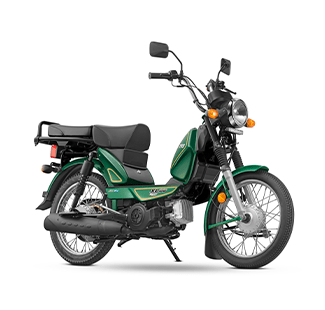
India’s moped segment is witnessing a decline in demand as rising ownership costs, a narrowing price gap with motorcycles and increasing competition from electric vehicles erode its affordability advantage, according to TVS Holdings Ltd.
In its Annual Report 2026, the core investment company and holding company of TVS Motor Company Ltd said mopeds, which account for just 2-4% of India’s two-wheeler sales, continue to be sold primarily in South India, with TVS Motor remaining the country’s sole manufacturer in the segment.
Rising prices hit affordability
The company said the moped segment’s traditional low-cost positioning has weakened over the years. The price difference between mopeds and motorcycles has narrowed significantly to ₹3,000-₹5,000 from around ₹8,000-₹10,000 earlier, largely due to product upgrades.
In addition, the implementation of Bharat Stage VI (BSVI) emission norms increased moped prices by 8-10%, making them less affordable for price-sensitive buyers.
Despite these challenges, mopeds remain popular in rural markets because of their versatility and suitability for family use. However, the shrinking price advantage and rapid adoption of electric vehicles are contributing to lower demand for the segment.
Scooter demand remains strong
In contrast, scooter demand grew 17% in fiscal 2026, driven by healthy income growth in urban and semi-urban markets, a normal monsoon and GST rate reductions.
TVS Holdings said urban markets account for 65-75% of scooter sales, although rural adoption is steadily increasing due to improved road infrastructure, rising female ridership and greater workforce participation.
Over the medium term, scooter demand is expected to remain robust as consumers increasingly view scooters as gender-neutral vehicles offering better fuel efficiency, convenience and a wider choice of models for intra-city mobility in tier-II and tier-III cities.
Three-wheeler growth to moderate
The company estimated India’s three-wheeler industry to have recorded volumes of around 7.9 lakh units in fiscal 2026, registering 11% year-on-year growth.
The expansion was supported by improved consumer sentiment following GST restructuring, a softer interest rate environment and accelerating adoption of electric three-wheelers.
For fiscal 2027, TVS Holdings expects volume growth to moderate to 5-7%, although continued improvements in financing conditions and sustained demand for electric three-wheelers are expected to support the sector.
Credit growth outlook positive
TVS Holdings also projected systemic credit to grow at a compound annual growth rate (CAGR) of 14-15% between fiscals 2026 and 2027.
The company expects MSME lending and secured retail segments, including vehicle and gold loans, to drive overall credit growth. It also noted that unsecured retail lending, including personal loans and microfinance, is showing early signs of stabilisation as lenders adopt stricter underwriting practices and asset quality improves through higher write-offs and better borrower discipline.
TVS Holdings operates as a core investment company with investments in TVS Motor Company and has a presence in the financial services business through its step-down subsidiary, TVS Credit Services Ltd, among others.