


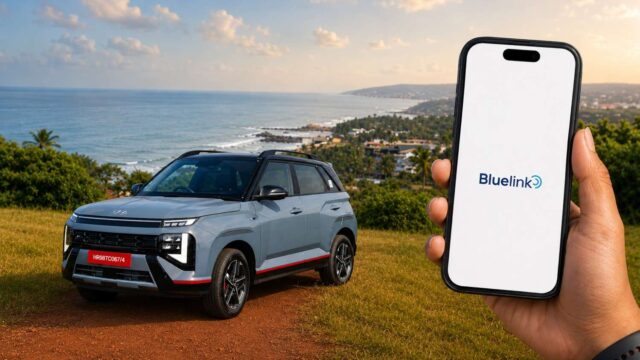
Hyundai Motor India Ltd (HMIL) is targeting cumulative sales of 1 million connected cars by 2027, as connected mobility gains traction among Indian car buyers.
The automaker currently has more than 0.8 million Hyundai connected cars on Indian roads, powered by its AI-enabled connected car platform, Hyundai Bluelink.
The company said the milestone reflects growing customer adoption of connected technologies and the increasing role of software and digital features in the vehicle ownership experience.
Bluelink offers 70-plus connected features
Hyundai Bluelink provides customers with more than 70 features spanning safety, security and convenience.
Key features include remote vehicle monitoring, vehicle health diagnostics, location tracking, trip history, remote commands, in-car payments through Hyundai Pay, Digital Key, Digital Passport, Remote Immobiliser and Home-to-Car Connectivity.
The platform also supports more than 450 AI-powered voice commands across five languages, enabling customers to interact with various vehicle functions using voice controls.
Hyundai Motor India, MD & CEO, Tarun Garg, said, “The growing adoption of connected vehicles reflects the evolving expectations of customers and the increasing role of technology in shaping mobility.”
“As we move towards our goal of 1 million connected car sales by 2027, we remain focused on advancing software-defined mobility and expanding connected technologies across our portfolio,” Garg added.
He said Hyundai’s upcoming mass-market electric SUV, which will offer next-generation connected car technology as standard across all variants, will further strengthen the convergence of connected and electric mobility.
Connected car penetration rises five-fold
Connected car adoption in India has increased significantly in recent years, driven by rising customer demand for greater convenience, safety and a more seamless ownership experience.
Hyundai introduced its Bluelink technology in India in 2019, bringing OEM-fitted connected car technology to Indian customers.
Since then, connected vehicle penetration across Hyundai’s portfolio has increased five-fold, from 4% in 2019 to 20% in 2026.
Models including the Creta, Venue and i20 have contributed to the growing adoption of connected technologies, reflecting increasing customer acceptance of digital and software-led vehicle features.
Focus on software-defined vehicles
HMIL’s technology roadmap is centred on Software Defined Vehicles (SDVs), connected mobility and continuous software innovation.
The company is also focusing on Over-the-Air (OTA) capabilities, which can enable software and connected features to be enhanced remotely without requiring customers to visit a dealership.
The shift is expected to make software an increasingly important part of the vehicle ownership experience, with connected technologies playing a larger role in vehicle functionality, safety and personalisation.
Bluelink strengthens safety and assistance
Beyond convenience features, Hyundai said Bluelink has delivered tangible benefits in emergency and safety situations.
More than 0.5 million motorists have been assisted through SOS and roadside assistance services. The technology has also supported around 15,000 crash notification interventions and helped law-enforcement agencies in vehicle tracing and recovery efforts.
Features such as Driving Score and Digital Passport are also designed to encourage safer driving and proactive vehicle maintenance by providing customers with personalised insights and recommendations.
With connected car penetration continuing to rise, Hyundai is positioning Bluelink and software-defined mobility as key elements of its future product strategy, while its planned mass-market electric SUV is expected to further integrate connected and electric mobility.