


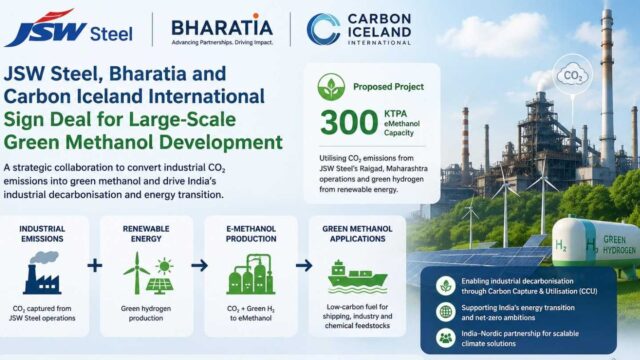
JSW Steel Ltd, Bharatia and Carbon Iceland International have signed a strategic memorandum of understanding (MoU) to jointly explore the development of a large-scale green methanol (eMethanol) project in India.
The proposed project, with a planned capacity of 300 KTPA, aims to utilise carbon dioxide emissions generated from JSW Steel’s operations in Raigad district of Maharashtra and convert them into eMethanol using green hydrogen produced through renewable energy sources.
Focus on industrial decarbonisation
The collaboration seeks to establish a scalable carbon capture and utilisation (CCU) pathway for the steel industry while supporting India’s broader energy transition and industrial decarbonisation goals.
According to the companies, the initiative is expected to demonstrate how industrial emissions can be transformed into low-carbon fuels and chemical feedstocks, creating a replicable framework for future green industrial infrastructure projects.
As part of the initial phase, the project will evaluate the utilisation of an existing high-purity CO₂ stream from JSW Steel’s facility while also assessing opportunities to capture additional emissions from steel manufacturing operations.
Roles of partner companies
Under the collaboration, JSW Steel will contribute large-scale industrial infrastructure and operational capabilities.
Bharatia will support project development, ecosystem integration, financing pathways and implementation architecture, leveraging its expertise across policy, technology and finance.
Carbon Iceland International will act as the technology project developer for carbon capture integration, e-fuels production and industrial decarbonisation pathways.
Supporting low-carbon fuel ecosystem
The companies stated that the initiative aligns with global efforts to develop low-carbon fuels for shipping, industrial applications and other hard-to-abate sectors.
The project is also expected to strengthen India’s position as an emerging hub for climate technology deployment and green industrial infrastructure development.
The MoU outlines a phased development pathway beginning with feasibility assessment and technical validation, followed by potential future commercial-scale implementation.
India-Nordic climate cooperation gains momentum
The agreement also highlights growing climate and industrial cooperation between India and the Nordic region, underlining the role of cross-border partnerships in accelerating scalable decarbonisation solutions for heavy industries and the wider Global South.