


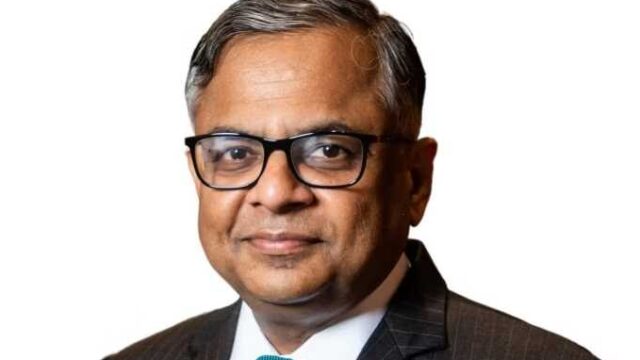
The N Chandrasekaran era at Tata Sons is drawing to a close, bringing to the fore one of the most daunting leadership challenges the Tata Group has faced in recent years.
Chandrasekaran, who has led Tata Sons since February 2017, said on Wednesday that he would not offer himself for reappointment when his current term ends on February 20, 2027. Importantly, he is not stepping down immediately and will continue as chairman until the end of his current term.
But his carefully worded statement reveals that his decision follows months of uncertainty over his proposed extension and a lack of unanimity at the Tata Sons Board.
Chandrasekaran began his statement by reflecting on his four decades with the Tata Group.
“I have completed 40 years of professional life at the Tata Group.”
Calling it an “immensely satisfying opportunity” to contribute to the institution, he said leading Tata Sons for the past decade had been “a great honour and a profound responsibility”.
The tone changes sharply when he explains why he has decided against another term.
The unresolved board decision
According to Chandrasekaran, the Sir Dorabji Tata Trust and Sir Ratan Tata Trust had “unanimously resolved and recommended” an extension of his next term for five years. The recommendation was also recorded by the Tata Sons Nomination and Remuneration Committee and the Board.
The proposal, however, hit a roadblock when it was placed before the Tata Sons Board on February 24, 2026.
“However, the proposal was not carried through because one of the Board Members did not support it.”
Chandrasekaran said that “in the absence of unanimous support, I chose to defer the decision.”
That sentence is perhaps the most revealing part of his statement.
Six months have since passed, but the issue remains unresolved.
“It has been 6 months since that Board meeting, and no resolution has been reached till date.”
For a group whose institutional culture has historically placed enormous emphasis on consensus, the inability to settle the chairman’s continuation for six months is significant.
Chandrasekaran does not spell out the identity of the Board member or go into the differences that prevented the proposal from going through. But his decision to make the lack of unanimity a central part of his statement makes it clear that the succession question is not merely a routine change of guard.
Why the timing matters
The timing makes the succession exercise even more critical.
Chandrasekaran points out that Tata Sons is “a very large institution” with “many strategic projects that are under critical stages of execution.”
His concern is not simply about who occupies the chairman’s chair. It is about the uncertainty that prolonged leadership ambiguity can create across the sprawling Tata ecosystem.
“It is not only necessary to have a leader in place to lead the Group beyond Feb 2027, but also clarity on leadership is important for employees, investors, partners and other stakeholders.”
That is also why the search for his successor is unlikely to be a simple exercise in replacing one chairman with another.
Over nearly a decade, Chandrasekaran has overseen a transformation of the Tata Group’s portfolio, including the return and rebuilding of Air India, expansion into semiconductors and electronics manufacturing, the group’s EV and battery ambitions and a renewed focus on large-scale manufacturing.
The successor will inherit these projects at varying stages of execution — and will have to decide which elements of the Chandra strategy need to be accelerated, recalibrated or abandoned.
The daunting succession task
The immediate challenge before Tata Sons is therefore to identify an individual who can command the confidence of the Board and Tata Trusts while providing strategic continuity to a group spanning technology, automobiles, steel, consumer businesses, aviation, hospitality, financial services and new-age manufacturing.
The leadership search also comes against the backdrop of reported differences over Chandrasekaran’s continuation. Recent reports have highlighted tensions around the February Board decision, although Chandrasekaran’s own statement does not identify the dissenting Board member or attribute the disagreement to any particular individual.
That makes his call for an early succession decision particularly important.
“I have asked the Board to decide on the succession soon to ensure a proper transition.”
This is not the language of someone seeking a prolonged battle over his tenure. Instead, Chandrasekaran appears to be drawing a line under the uncertainty and giving the Board time to find a successor.
End of an era
Chandrasekaran’s exit will mark the end of a remarkable chapter in Tata’s modern history.
He became the first non-Tata professional to lead Tata Sons after the turbulent period that followed Ratan Tata’s retirement and the short-lived tenure of Cyrus Mistry. His elevation from within the Tata Group’s flagship TCS gave him deep knowledge of the organisation and its culture.
His decade at the top has also coincided with an unusually ambitious phase of capital deployment and diversification.
Now the Tata Group must find the person who can take that agenda forward — without being trapped by it.
Chandrasekaran’s statement ends on a deliberately gracious note:
“I am grateful for the support of all stakeholders.”
But beneath that gracious exit lies a much bigger corporate question.
Who will lead Tata Sons after February 20, 2027, and can that person restore the consensus that has proved elusive over Chandrasekaran’s own succession?
The Chandra era has effectively entered its final chapter. The search for what comes next has begun.