


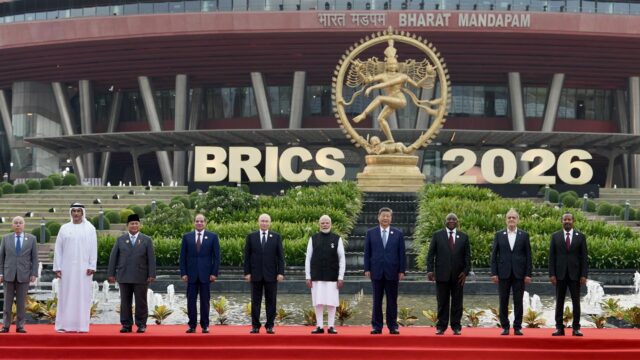
BRICS leaders have called for a stronger, more resilient and inclusive economic partnership among member countries, with greater cooperation on cross-border payments, local-currency settlements, critical minerals, global value chains, artificial intelligence and development finance.
The commitments are part of the BRICS New Delhi Declaration, adopted at the XVIII BRICS Summit held in New Delhi under India’s 2026 chairship. The summit also marked the 20th anniversary of BRICS, with leaders reiterating their call for a more representative global governance system and a stronger voice for emerging markets and developing economies (EMDEs).
The declaration signals that BRICS is seeking to move beyond a political grouping towards deeper practical cooperation in trade, finance, technology, infrastructure and supply chains.
Local currencies gain traction
One of the key economic areas identified by the leaders is cross-border payments.
The BRICS Payment Task Force has been examining the interoperability of payment and messaging channels and the possibility of promoting trade settlements and investments using local currencies.
The leaders called for continued work on practical cross-border payment solutions that are faster, lower-cost, more accessible, efficient, transparent and safe. At the same time, they acknowledged that there is no one-size-fits-all approach and that national priorities need to be respected.
The approach stops short of proposing a single BRICS currency. Instead, the emphasis is on improving payment connectivity and creating greater scope for transactions in members’ own currencies.
For businesses, deeper payment interoperability could eventually reduce friction in intra-BRICS trade and investment, particularly if payment systems become more integrated and settlement costs fall.
Critical minerals become a strategic priority
BRICS has also placed critical minerals firmly within its economic and energy-security agenda.
The declaration calls for reliable, diversified, resilient and sustainable critical-mineral supply chains, while stressing benefit sharing, value addition and economic diversification in resource-rich countries.
The leaders recognised the importance of critical minerals for zero- and low-emission energy technologies, energy security and resilient supply chains. They also stressed that resource-rich countries should retain sovereign rights over their mineral resources.
The emphasis on value addition is significant because it points towards cooperation not merely in mining, but potentially across processing, technology and manufacturing linked to critical minerals.
For BRICS economies seeking greater control over strategic supply chains, this could become an important area of industrial cooperation.
Supply chains and manufacturing
The declaration places considerable emphasis on strengthening global value chains and increasing the participation of emerging and developing economies in higher-value manufacturing.
BRICS members agreed to work towards more resilient, reliable and stable supply chains and promote trade, investment, technical cooperation, productive capacity and technology transfer.
The group also backed the development of the BRICS Global Value Chain Action Plan 2026-2030, with particular attention to the challenges faced by emerging and developing economies in moving up the value chain.
Special Economic Zones are also being viewed as potential platforms for trade, investment and industrial cooperation, with BRICS seeking greater use of digital trade documentation to make cross-border commerce more efficient.
MSMEs get a financing push
The declaration recognises access to affordable finance as a major constraint on the internationalisation of Micro, Small and Medium Enterprises.
BRICS leaders welcomed guiding principles for credit assessment of export-oriented MSMEs that use diverse data sources to improve risk assessment and expand access to formal finance.
They also welcomed the Jaipur Consensus to study an invoice discounting mechanism for BRICS members. Such a mechanism could help smaller businesses unlock working capital against invoices and strengthen their participation in international trade.
This could be particularly relevant for smaller exporters that struggle with working-capital requirements despite having confirmed orders or receivables.
Development finance and insurance
The New Investment Platform remains under technical discussion, with members supporting a consensus-based, phased and member-driven approach.
BRICS also welcomed progress on the Multilateral Guarantees initiative, which could help mobilise private capital, improve the creditworthiness of projects and lower financing costs for development projects in BRICS and the wider Global South.
Insurance is another emerging area of cooperation
The declaration supports discussions on a BRICS Insurance Resilience Centre and notes interest in India’s proposal to host a BRICS Risk Lab at Gujarat International Finance Tec-City (GIFT City) International Financial Services Centre.
The proposed mechanisms are aimed at developing common risk models, sharing expertise and strengthening reinsurance capacity among participating BRICS economies.
The New Development Bank, meanwhile, is expected to play a larger role in mobilising resources, expanding local-currency financing and supporting infrastructure and sustainable development projects in emerging economies.
AI, digital infrastructure and technology
Artificial intelligence and digital infrastructure feature prominently in the declaration.
BRICS leaders recognised AI’s potential to drive economic growth and sustainable development, while calling for cooperation that improves accessibility to AI resources and ensures safety, security, inclusiveness and reliability.
They also backed cooperation on trustworthy AI, energy-efficient AI systems, AI science and innovation, and the use of AI for economic growth and social good.
The grouping is also looking at digital public infrastructure, digital public goods, digital skilling and future networks.
A proposed BRICS digital public infrastructure repository and pilot projects could facilitate the exchange of solutions for digital transformation among member countries.
The declaration also highlights the potential for a high-speed submarine cable network connecting BRICS countries, with discussions continuing on a technical and economic feasibility study.
Energy security remains central
BRICS has adopted a broad approach to energy security, recognising that fossil fuels will continue to have a role, particularly for emerging markets and developing economies, while supporting orderly and inclusive energy transitions.
The declaration calls for diversified energy mixes spanning renewable energy, bioenergy, fossil fuels, nuclear energy, hydropower, hydrogen, low-carbon technologies and energy storage.
It also highlights the use of AI and advanced data analytics for grid management, renewable integration and energy infrastructure resilience.
Geopolitical tensions and trade risks
The declaration comes against a backdrop of geopolitical fragmentation, protectionism and disruption to global supply chains.
BRICS expressed concern over unilateral tariffs and non-tariff measures that it said could distort trade, disrupt supply chains and increase uncertainty in global economic activity.
The grouping reiterated support for a rules-based multilateral trading system centred on the World Trade Organization and called for restoration of an effective two-tier WTO dispute settlement mechanism.
The leaders also called for diplomatic efforts to reduce conflict risks and highlighted the importance of maintaining the flow of global trade, energy and supply chains amid continuing tensions in West Asia.
India’s 2026 chairship sets the platform for 2027
The declaration credited India with advancing the BRICS economic partnership agenda and noted progress towards the BRICS Strategy for Economic Partnership 2030.
India’s chairship included more than 400 meetings and engagements involving ministers, parliamentarians, officials, experts, businesses and people across 30 cities.
With China taking over the BRICS chairship in 2027, the New Delhi Declaration provides a broad agenda spanning trade, finance, technology, energy, critical minerals, infrastructure and global governance.
For businesses, the immediate significance lies less in a single headline initiative and more in the emerging architecture of cooperation, from local-currency payments and MSME finance to resilient supply chains, digital infrastructure and critical-mineral partnerships.
The challenge now will be converting these broad commitments into operational mechanisms that businesses, investors and financial institutions can actually use.