


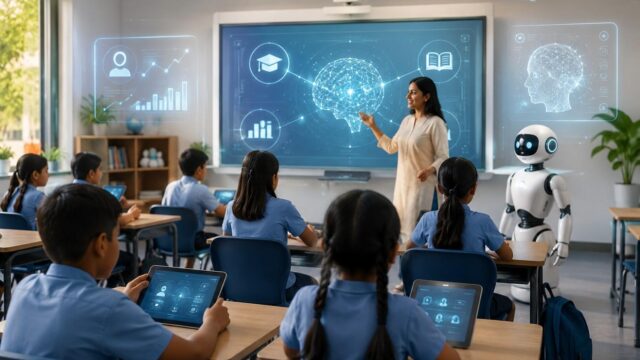
Wadhwani AI, in collaboration with The Bridgespan Group and with support from Google.org, has released a report titled “Harnessing AI in Education for Future Readiness: Bold Bets for Every Learner,” outlining a system-level roadmap to integrate responsible artificial intelligence into India’s public education ecosystem.
The report focuses on scaling AI adoption across government education systems while ensuring inclusion, long-term impact and responsible deployment. It comes at a time when India serves more than 250 million students across 1.5 million schools, with nearly 60% of learners enrolled in government and government-aided institutions.
NEP lays the foundation for smart classes
According to the report, policy initiatives such as the National Education Policy (NEP) 2020, coupled with digital public infrastructure including DIKSHA and NDEAR, have laid the foundation for embedding AI into public education systems.
The report identifies three interconnected pathways through which AI can strengthen India’s education ecosystem. These include expanding equitable learning opportunities, improving learning outcomes through adaptive and data-driven approaches, and enhancing work readiness by creating stronger links between education and employment pathways.
It estimates that AI-enabled education could contribute nearly $2.6 trillion to India’s GDP by 2047 and increase annual GDP growth by up to one percentage point, supporting the country’s Viksit Bharat 2047 vision.
Seven bold bets identified
To drive long-term transformation, the report outlines seven priority areas or “Bold Bets” across the education-to-employment continuum. These include personalised learning, AI-powered teacher support, multilingual access, early childhood education, career navigation, skill development and socio-emotional learning.
The report estimates that successful implementation of these initiatives within public systems could eventually benefit up to 350 million learners.
Early deployments show encouraging results
The report highlights that AI solutions are already delivering measurable outcomes across several states.
AI-enabled Oral Reading Fluency (ORF) assessments have supported more than 27 million assessments covering 8.5 million students, while adaptive learning platforms have demonstrated 2-3x improvements in learning outcomes during controlled evaluations.
Initiatives help students through the path
It also cites initiatives such as Pratham’s AI-enabled PadhAI platform for multilingual literacy assessments and Antarang’s AI-assisted career guidance solutions that help students navigate education-to-employment pathways.
Wadhwani AI’s solutions, including Oral Reading Fluency and Spoken English Assessment & Practice (SEAP), have already been integrated into government systems to enable large-scale assessments, personalized feedback and continuous monitoring of learning outcomes.
Focus on responsible AI adoption
Wadhwani AI Head Shekar Sivasubramanian said, “Technology on its own will not change how education systems function. What will matter is how it is combined with strong systems, teachers, data, and safeguards to support learning in a sustained way. As we see more solutions move into real-world environments, the focus needs to remain on what works for learners and educators at scale, and how these approaches can continue to evolve within public systems.”
Continuous access to quality education is crucial
Google.org Head of APAC Grantmaking Marija Ralic, said, “At Google.org, we have always supported change makers who work to scale digital resources for learners. We believe deeply that continuous access to quality education is the foundation of the future, and that AI can play an instrumental role in building it. We are excited to see AI for Education Innovation strengthen infrastructure and support teachers and learners across India, ultimately ensuring that we help unlock potential to learn new skills at scale.”
Long-term investment, sustained outcomes
The Bridgespan Group Partner Anant Bhagwati said, “As the education system continues to evolve, one of the key priorities will be identifying where focused, long-term investment can help translate early progress into sustained outcomes at scale. This includes domestic philanthropy and CSR supporting bold bets that are designed for real system conditions, building strong evidence, and enabling approaches that can be adopted within public systems over time.”
Collaboration seen as key
The report stresses that collaboration among governments, philanthropy, civil society organisations and technology partners will be critical for embedding AI into existing digital public infrastructure.
It concludes that responsible AI adoption can play a pivotal role in strengthening India’s education system by supporting teachers, improving learning outcomes and preparing students with future-ready skills while ensuring equitable access at scale.