


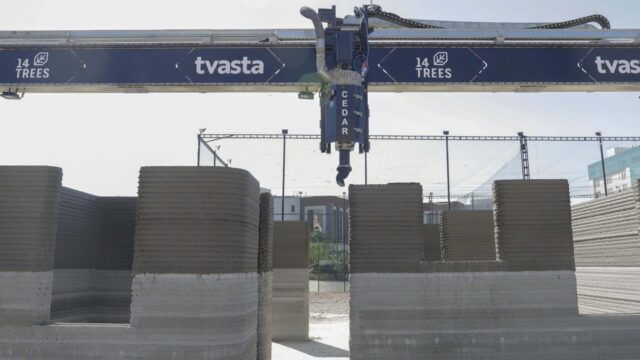
Tvasta Manufacturing Solutions, the IIT Madras alumni-led deep-tech startup, has partnered with 14Trees to develop and launch Cedar, an AI-ready 3D concrete printer aimed at accelerating construction automation globally.
Designed and manufactured in India by Tvasta, Cedar combines advanced robotics, large-scale build capabilities and AI-driven material optimisation to make construction 3D printing faster, more economical and easier to deploy at scale.
The companies said the platform has been developed to support the next phase of industrial-scale automation in the construction sector.
India-built platform targets global markets
Tvasta and 14Trees are expanding their international footprint with operations and clients spread across the United States, Europe, West Asia, Asia and Africa.
Cedar has been engineered using scalable industrial manufacturing processes, enabling consistent quality, rapid deployment and operational flexibility across diverse construction environments.
The portal-frame concrete printer is expected to support developers, infrastructure firms, contractors and public sector agencies looking to improve construction speed, efficiency and cost economics.
Tvasta builds on IIT Madras innovation roots
Founded in 2016 by IIT Madras alumni and headquartered in Chennai, Tvasta has focused on leveraging automation, robotics and additive manufacturing technologies to transform conventional construction methods.
The startup has developed multiple 3D printing platforms aimed at delivering faster, more sustainable and cost-effective construction solutions.
Partnership combines engineering and material science expertise
The companies said Cedar represents a significant evolution in construction 3D printing technology by integrating Tvasta’s robotic engineering and industrial manufacturing capabilities with 14Trees’ strengths in design optimisation, material science and large-scale project execution.
The collaboration aims to improve the scalability, accessibility and commercial viability of concrete 3D printing for mainstream construction applications.
Focus shifts from technical viability to commercial scale
14Trees CEO Francois Perrot said:“Construction 3D printing has already proven its technical viability. For the technology to scale across the global construction industry, it must also make strong economic sense for developers and contractors. Cedar was designed to dramatically improve project economics, lowering the cost barrier and enabling construction companies to deploy 3D printing at scale.”
Cedar designed for diverse construction environments
Tvasta Manufacturing Solutions CEO Adithya V S, said :“By combining advanced manufacturing capabilities with cutting-edge robotics and software, Cedar delivers a robust and reliable system built for deployment across highly diverse construction environments.”
Real concrete capability cuts material costs
One of Cedar’s key innovations is its ability to print using standard concrete formulations instead of specialised mortar-based materials typically used in construction 3D printing systems.
The companies said this approach significantly improves local sourcing flexibility while reducing material costs by up to five times, making industrial 3D printing more commercially viable for mainstream construction projects.
AI platform optimises construction materials
A core component of the Cedar ecosystem is the 14Trees AI Companion, a digital platform designed to optimise material performance using locally available resources.
Powered by AI-driven analysis of thousands of mix designs, the platform helps project teams identify the optimal balance between structural performance, cost efficiency and environmental impact.
Track record spans housing and infrastructure projects
Over the past few years, Tvasta and 14Trees have jointly delivered several flagship 3D-printed buildings across multiple segments including housing, educational facilities, offices and technical infrastructure projects.
The companies said these projects have demonstrated the practical viability of construction 3D printing as a faster and more efficient building method.