


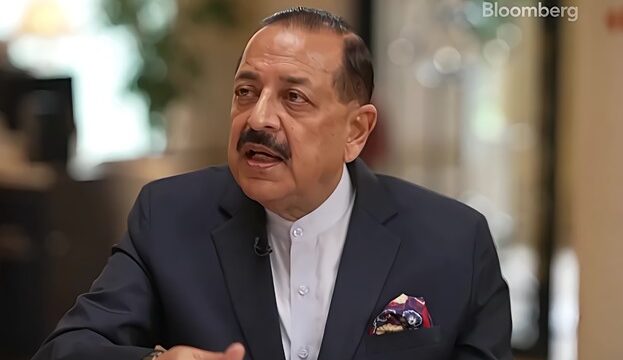
India’s nuclear energy programme will play a growing role in meeting the country’s future electricity requirements, particularly the rising demand from artificial intelligence (AI) applications and data centres, Union Minister Dr. Jitendra Singh has said.
Speaking on the sidelines of the Bloomberg Economy Forum 2026, the Minister reiterated that India’s nuclear programme was dedicated to peaceful purposes and national development, while highlighting the importance of reliable, low-carbon electricity for the country’s expanding technology economy.
India has set a target of achieving 100 GW of nuclear power capacity by 2047, alongside its commitment to achieving Net Zero emissions by 2070. Nuclear energy is expected to complement renewable and other power sources by providing a continuous supply of electricity, including when solar and wind generation fluctuate.
AI and data centres drive demand for reliable power
Dr. Jitendra Singh said the growing adoption of AI and the expansion of data centres would increase the need for dependable electricity supplies capable of supporting energy-intensive operations around the clock.
As India expands its digital infrastructure, nuclear power could become an important component of its energy strategy, helping meet the requirements of an increasingly technology-driven economy.
The Minister said India’s approach to nuclear energy continued to reflect the vision of Dr. Homi Bhabha, the architect of the country’s nuclear programme, who championed the peaceful application of nuclear technology for national development.
The expansion of nuclear capacity is expected to support India’s long-term energy security while contributing to its efforts to reduce carbon emissions.
Human judgement remains critical in AI adoption
On the wider application of AI, Dr. Jitendra Singh said the technology should be viewed as a tool that could be deployed across sectors rather than as an independent domain.
From space research and life sciences to other areas of scientific and technological development, AI is expected to become an increasingly important instrument for research, innovation and productivity.
Emphasising the importance of human judgement, he said, “One has to be intelligent enough to use Artificial Intelligence.”
The Minister acknowledged that AI offered significant advantages but said preventing its misuse remained a major challenge. While regulatory frameworks were important, he stressed that integrity at the individual and national levels was essential to ensuring responsible use of the technology.
He also highlighted the efforts made under Prime Minister Narendra Modi to promote the appropriate use of AI and strengthen India’s technological capabilities.
Private sector participation expands in strategic areas
Dr. Jitendra Singh also pointed to the opening of critical and sensitive sectors to non-government players under the Modi government.
The move has widened opportunities for private companies to contribute to technological advancement, innovation and national development in areas that were traditionally more restricted.
Greater private sector participation could help mobilise investment, expertise and entrepreneurial capabilities as India builds the infrastructure needed to support its long-term economic and technological ambitions.
The Minister’s remarks highlight the growing links between energy security, digital infrastructure and industrial development. As AI adoption accelerates and data centre capacity expands, ensuring access to reliable electricity will become increasingly important.
India’s nuclear expansion, combined with renewable energy and wider industry participation, is expected to form part of its strategy to meet rising power demand while advancing towards its 2047 development goals and 2070 Net Zero commitment.