


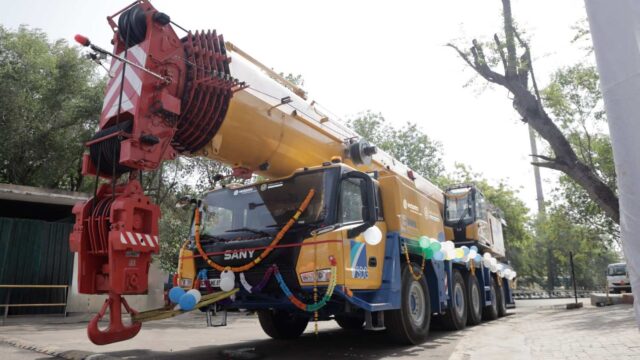
Hindustan Zinc Ltd, the world’s largest integrated zinc producer and a Vedanta Group company, has deployed India’s first 250-metric-tonne capacity electric crane at its Zinc Smelter Debari in Rajasthan.
The hybrid lifting machine, capable of operating on both diesel and electric power, marks a significant step in the company’s journey to decarbonise core operations and integrate clean technologies across industrial infrastructure.
Advancing green mobility
The deployment is the latest milestone under the company’s green roadmap, which is focused on building a wider sustainability fleet.
Over the past three years, Hindustan Zinc has rolled out a broad range of clean mobility solutions across its operations, ranging from India’s first underground battery electric vehicles (BEVs) to electric and LNG-powered logistics fleets.
In partnership with GreenLine Mobility, the company has established Rajasthan’s largest EV bulker fleet with 40 electric bulkers. It has also recently deployed its first two electric buses for employee transportation as part of a 41-bus green mobility initiative, which includes Rajasthan’s first EV passenger buses.
Earlier this year, the company launched four electric loaders at the Rampura Agucha Mine, further expanding the footprint of electric-powered equipment across its operations.
Decarbonisation focus
Hindustan Zinc, CEO, Arun Misra said, “At Hindustan Zinc, sustainability is deeply embedded in how we operate, innovate and grow. The deployment of India’s first 250 MT electric crane is another example of our resolve to adopt clean technology and redefine how core industry transitions to low-carbon solutions.
“This initiative reflects our efforts to foster a culture of sustainability while laying the foundation for a greener and more resilient industrial ecosystem.”
The company said the crane is expected to reduce on-site emissions significantly and avoid approximately 250.8 tCO₂e annually by replacing a diesel-operated crane that consumes around 93,600 litres of diesel per year.
The deployment is also expected to improve operational energy efficiency and demonstrate the scalability of hybrid technologies in hard-to-abate industrial sectors.
Technology partnership|
SANY India, Managing Director, Deepak Garg said, “Hindustan Zinc has consistently demonstrated industry leadership in adopting technologies that redefine sustainable mining.
“At SANY, we are honoured to partner with the company in deploying India’s first 250-tonne diesel-electric hybrid all-terrain crane, a solution designed to improve energy efficiency, reduce emissions and support more responsible industrial operations.
“This milestone reflects our shared commitment to advancing innovation that delivers both operational excellence and meaningful environmental impact.”
Building a low-carbon future
In 2022-23, Hindustan Zinc became the first company in India to deploy underground BEVs at Sindesar Khurd Mine, one of the world’s largest silver-producing underground mines.
The initiative has since evolved into a multi-unit model, demonstrating the effectiveness of cleaner alternatives in complex underground mining environments.
Further strengthening this transition, more than 250 LNG trucks now transport concentrate between mining sites and smelters, making Hindustan Zinc Rajasthan’s largest LNG fleet operator in industrial logistics.
The company’s climate action initiatives are aligned with the United Nations Sustainable Development Goals 2030, particularly those focused on clean energy, climate action, responsible production and sustainable industrial innovation.
Net zero roadmap
These initiatives are supported by the company’s decarbonisation roadmap aimed at achieving Net Zero emissions by 2050 or earlier.
As the first Indian company to join the International Council on Mining and Metals (ICMM), Hindustan Zinc continues to improve energy efficiency, reduce its carbon footprint and accelerate clean energy adoption.
The company has increased renewable energy to nearly 18% of its power mix, commissioned over 530 MW of round-the-clock renewable energy capacity, and aims to reduce Scope 1 and Scope 2 emissions by 50% and Scope 3 emissions by 25% from the 2020 baseline.