


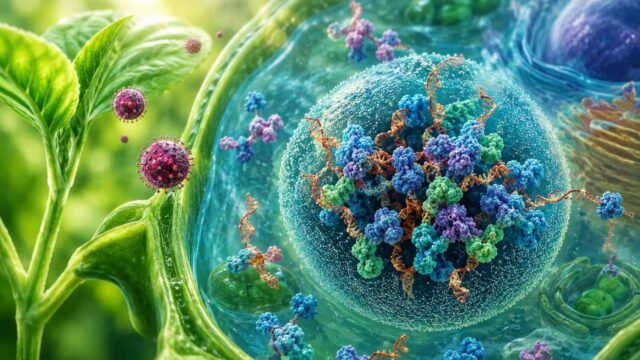
Scientists at CSIR-Centre for Cellular and Molecular Biology (CCMB) have uncovered a crucial plant defence mechanism that helps plants fight viral infections using liquid-like sticky protein droplets that trap and disable invading viruses.
The breakthrough study, led by Dr Mandar V. Deshmukh and published in the Journal of the American Chemical Society (JACS), provides a detailed molecular-level explanation of how plants prevent viruses from replicating inside infected cells.
How plants stop viruses from multiplying
Many viruses carry double-stranded RNA as their genetic material. When plants are attacked by such viruses, they increase the production of specialised RNA-binding proteins capable of recognising viral RNA.
These proteins bind to the viral replication complexes, the machinery viruses use to multiply, and effectively halt the replication process. Without the ability to replicate their genetic material, viruses fail to spread within plant cells.
While scientists already knew these proteins played a defensive role, the precise mechanism through which they interacted with viral RNA had remained unclear until now.
Researchers discover molecular glue mechanism
Using advanced technologies including Nuclear Magnetic Resonance (NMR) spectroscopy, fluorescence microscopy and molecular dynamics simulations, the CCMB team discovered that these RNA-binding proteins possess a unique structural fold.
The researchers found that electric charges distributed across the surface of the proteins create sticky patches that attract one another. Positive and negative charges interact to form interconnected protein networks, eventually creating dense, gel-like droplets inside cells.
“These proteins act like a molecular glue,” said Dr Jaydeep Paul, the first author of the study.
“By forming these dense, gel-like droplets, the plant cells effectively trap the viral RNA, preventing it from interacting with the machinery needed for replication,” he explained.
Biomolecular condensates reshape understanding of cells
The study also sheds light on biomolecular condensates, liquid-like structures increasingly recognised as critical to how living cells function.
“Rather than a collection of static membrane-bound compartments like the nucleus and mitochondria, the cell is now seen as a dynamic environment in which membraneless organelles form like oil droplets in water,” said Dr Deshmukh.
He added that understanding these dynamic states has important implications not only for basic science but also for agricultural and medical biotechnology applications.
Big implications for agriculture and medicin
The findings could open up new possibilities for developing crops with stronger natural resistance to viral diseases that cause billions of dollars in agricultural losses globally.
Scientists believe future crop varieties could be engineered to strengthen or mimic these protein-based traps, making plants more resilient to viral outbreaks.
The discovery may also have implications beyond agriculture. Researchers say similar mechanisms in human cells could potentially be manipulated to dissolve neurotoxic protein clumps linked to dementia or break down liquid barriers that help tumours grow.
A deeper understanding of these sticky protein interactions could eventually pave the way for designing highly targeted drugs capable of controlling harmful protein condensates in human diseases.