

For TVS Motor Company, Sri Lanka is increasingly becoming more than an export market. Its latest launches suggest that the company is positioning the island nation as an important market for its international electric-mobility ambitions.
The launch of the TVS King EV MAX electric three-wheeler and the TVS Orbiter electric scooter within a short span is significant because the two products address two distinct but complementary mobility segments, commercial passenger transport and personal urban commuting.
The strategy gives TVS a wider canvas to build its electric vehicle presence while leveraging the brand recognition, distribution network and after-sales infrastructure it has already established in Sri Lanka.
From conventional mobility to electric mobility
Sri Lanka is a particularly relevant market for this strategy. Three-wheelers are deeply embedded in the country’s urban mobility ecosystem, supporting livelihoods, tourism and last-mile connectivity.
For TVS, electrification of this segment offers an opportunity to move beyond selling a vehicle and address the economics of mobility.
The King EV MAX is clearly designed around that proposition. With a claimed range of 179 km on a single charge, an 11 kW motor, a top speed of 60 km/h and fast charging from 0 to 80% in 2 hours and 30 minutes, the vehicle is targeted at maximising uptime.
Its six-year or 150,000-km warranty further addresses one of the biggest concerns for commercial EV buyers, long-term reliability.
“As fuel prices continue to rise, the TVS King EV MAX provides an economical alternative, enabling customers to lower running costs, enhance monthly savings, and improve overall profitability,” said TVS Motor Company Vice President, International Business, Madhu Prakash Singh.
That is perhaps the most important part of TVS’s proposition. For a commercial three-wheeler operator, EV adoption is ultimately a business decision. Lower fuel and maintenance costs, combined with greater vehicle uptime, can directly influence earnings.
The Orbiter widens the EV funnel
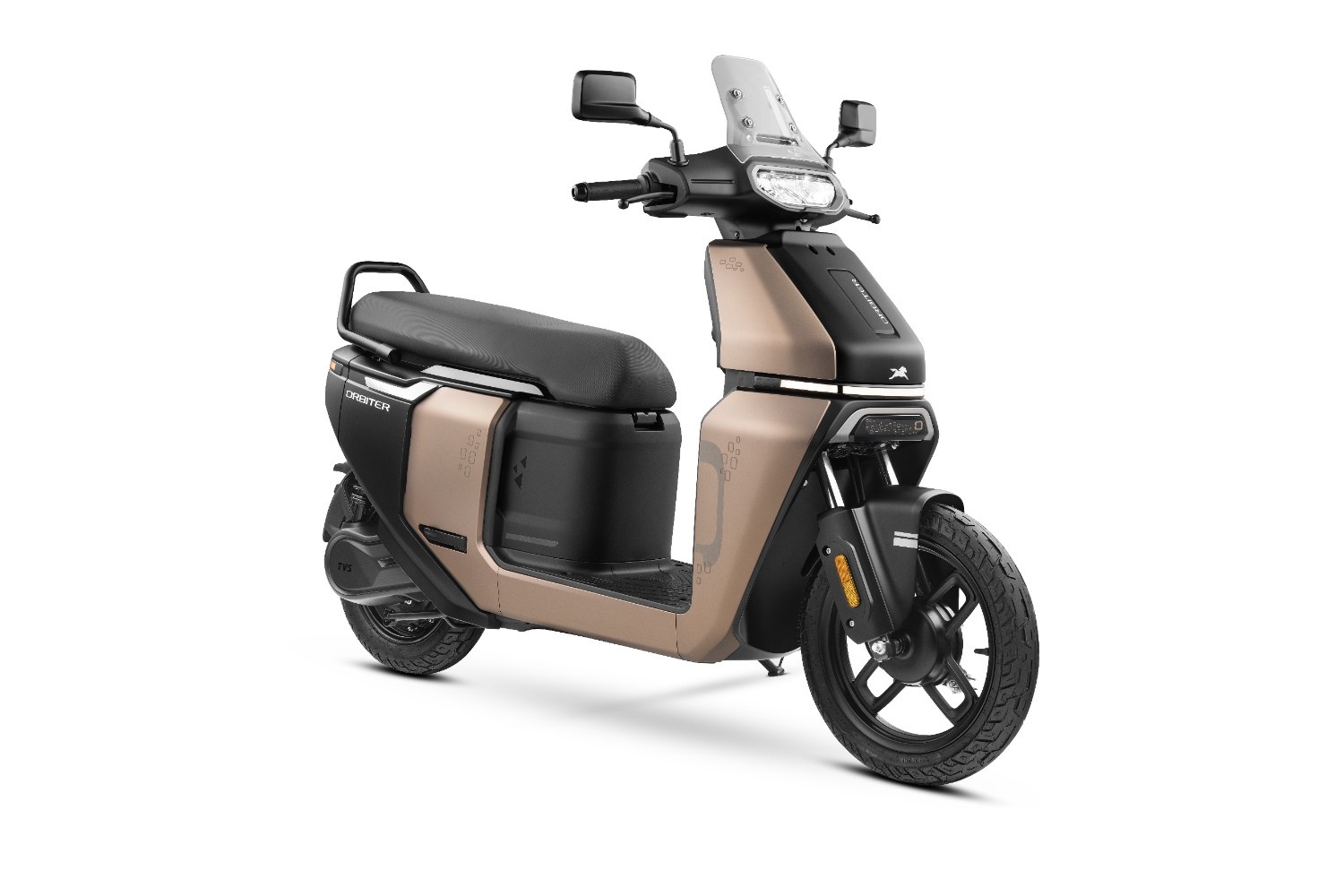
The TVS Orbiter takes the company into a different segment, young urban consumers and personal mobility.
The scooter comes with a 3.1 kWh battery, claimed IDC range of 158 km and a real-world range of 115 km. Features such as cruise control, hill-hold assist, parking assist, connected technology and 34-litre boot space are aimed at making the product aspirational as well as practical.
The launch also builds on TVS’s existing electric scooter presence in Sri Lanka through the TVS iQube.
TVS Motor Company President, International Business, Peyman Kargar said, “The TVS Orbiter is purposefully designed to transform urban commuting by making it cleaner, smarter, and more efficient. Combining advanced technology with practical everyday usability, it reflects our vision of creating meaningful mobility solutions that enrich lives while contributing to a more sustainable future.”
Building an ecosystem, not just selling EVs
This is where TVS’s strategy becomes more interesting.
The company is increasingly talking about the ecosystem around its products, sales reach, after-sales support, spare-parts availability, service readiness and trained EV specialists.
The emphasis on local operating conditions is equally important. TVS says the King EV MAX has been rigorously tested under Sri Lankan conditions, suggesting that the company is seeking to localise its EV proposition rather than simply introduce an existing international product.
At the country level, Geethal Anthony, CEO, TVS Lanka, sees the opportunity extending beyond the individual launches.
That focus could prove crucial.
The real battle is after the launch
Sri Lanka’s EV market is not without competition. Electric two-wheelers are already gaining traction, while several international and local players are competing for a share of the emerging market.
For TVS, therefore, brand familiarity alone will not guarantee leadership.
The more important battle will be fought after the vehicle is sold.
Battery warranties, service infrastructure, availability of replacement parts, trained technicians and customer confidence will determine whether consumers move from experimenting with EVs to adopting them as mainstream transportation.
For commercial three-wheelers, the stakes are even higher. A vehicle off the road means lost income. Consequently, reliability and service support can be as important as range, acceleration or connected features.
TVS appears to be building its proposition around precisely this equation.
The King EV MAX comes with a six-year/150,000-km warranty, while the Orbiter carries a five-year/60,000-km warranty on both battery and motor. Such assurances are designed to reduce the perceived risk of EV ownership.
From product exports to ecosystem building
The larger strategic message from the two launches is that TVS appears to be moving from product-led exports to ecosystem-led internationalisation.
The company already has a substantial conventional two- and three-wheeler presence in Sri Lanka. It can now potentially use that installed base to accelerate EV adoption.
The Orbiter expands the addressable consumer market. The King EV MAX gives TVS a foothold in commercial electric mobility. The iQube provides an existing premium electric scooter proposition.
Together, these products allow TVS to address different customer segments rather than depend on a single EV model.
Sri Lanka provides TVS with a market where fuel economics, urban mobility requirements and growing EV acceptance converge. If the company can successfully combine products with distribution, service and customer assurance, the experience could become a template for other emerging international markets.