

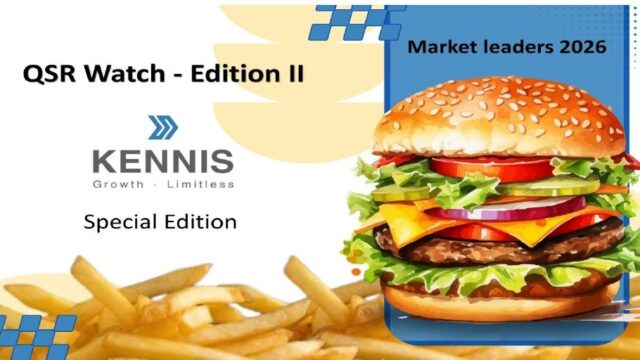
India’s organised burger market is moving into a new phase of expansion, with leading chains increasingly looking beyond major metros towards Tier II and Tier III cities, according to the latest QSR Watch – Edition II report by Kennis Ventures Pvt Ltd.
The report, which tracks the physical retail footprint of India’s top 10 organised burger chains, found that their combined store network increased from 1,481 outlets in 2023 to 2,018 outlets as of March 2026, representing a 10.9% CAGR.
The expansion comes as India’s overall QSR industry is estimated at around $30 billion in 2026, while the organised burger segment is estimated to be worth more than $5 billion.
Global brands dominate, Indian chains gain scale
McDonald’s and Burger King remain the only two global brands among the top 10 chains tracked by the report. Together, they account for 1,246 outlets, or 61.7% of the total network.
McDonald’s leads by store count with 676 outlets across 136 cities, while Burger King has the widest geographic presence, with 570 outlets across 159 cities.
At the same time, Indian-founded chains are building significant scale. The eight home-grown brands collectively operate 772 outlets, accounting for 38.3% of the top 10 network.
Jumboking ranks third with 172 outlets, followed by Burger Singh with 161, Biggies Burger with 113 and The Burger Company with 100 outlets.
Kennis Ventures Managing Director Saurabh Agarwal said the burger QSR market is shifting from a predominantly metro-led category to a more geographically distributed consumer opportunity.
South, East India gain momentum
The regional numbers point to a significant change in the geography of burger consumption.
North India remains the largest market with 837 stores, followed by West India with 624, South India with 438 and East India with 119.
However, South India recorded the strongest expansion among the larger regional markets, with its store base rising 80.2% from 243 to 438 outlets between 2023 and 2026.
East India more than doubled its network from 59 to 119 outlets, although from a much smaller base. North and West India expanded 48.4% and 39.6%, respectively.
The relatively low penetration in East India suggests considerable room for further organised QSR expansion.
Smaller cities become the next battleground
The shift is also visible beyond India’s traditional QSR hubs. Burger King has expanded into cities such as Itanagar, Dimapur and Shillong, while Burger Singh has entered Ayodhya and Jhansi. The Burger Company has established outlets in markets including Azamgarh, Hathras, Mau and Banda.
This indicates that the next phase of growth may depend less on adding outlets in saturated metros and more on identifying emerging consumption centres with rising purchasing power, younger populations and growing acceptance of organised food formats.
For investors and operators, the geographic expansion could create a new set of opportunities—but also raises the importance of store-level economics, supply-chain efficiency and brand localisation in smaller markets.
Metro markets remain important
Delhi NCR continues to lead India’s major urban markets with 364 outlets, followed by Mumbai Metropolitan Region with 288, Bengaluru with 181, Pune with 100 and Hyderabad with 74.
Yet Bengaluru and Pune are expanding faster, with store networks growing 53.4% and 56.3%, respectively, since 2023. Hyderabad recorded 32.1% growth.
The data suggests that while India’s largest metros will remain crucial to the burger chains, the industry’s growth map is steadily broadening.
For the organised burger segment, the strategic question is therefore shifting from how many outlets can be added in existing markets to where the next sustainable pockets of demand will emerge.
Kennis Ventures said the report is aimed at providing investors, financial institutions and F&B stakeholders with insights into competitive positioning, geographic penetration and emerging opportunities in India’s organised burger QSR market.