


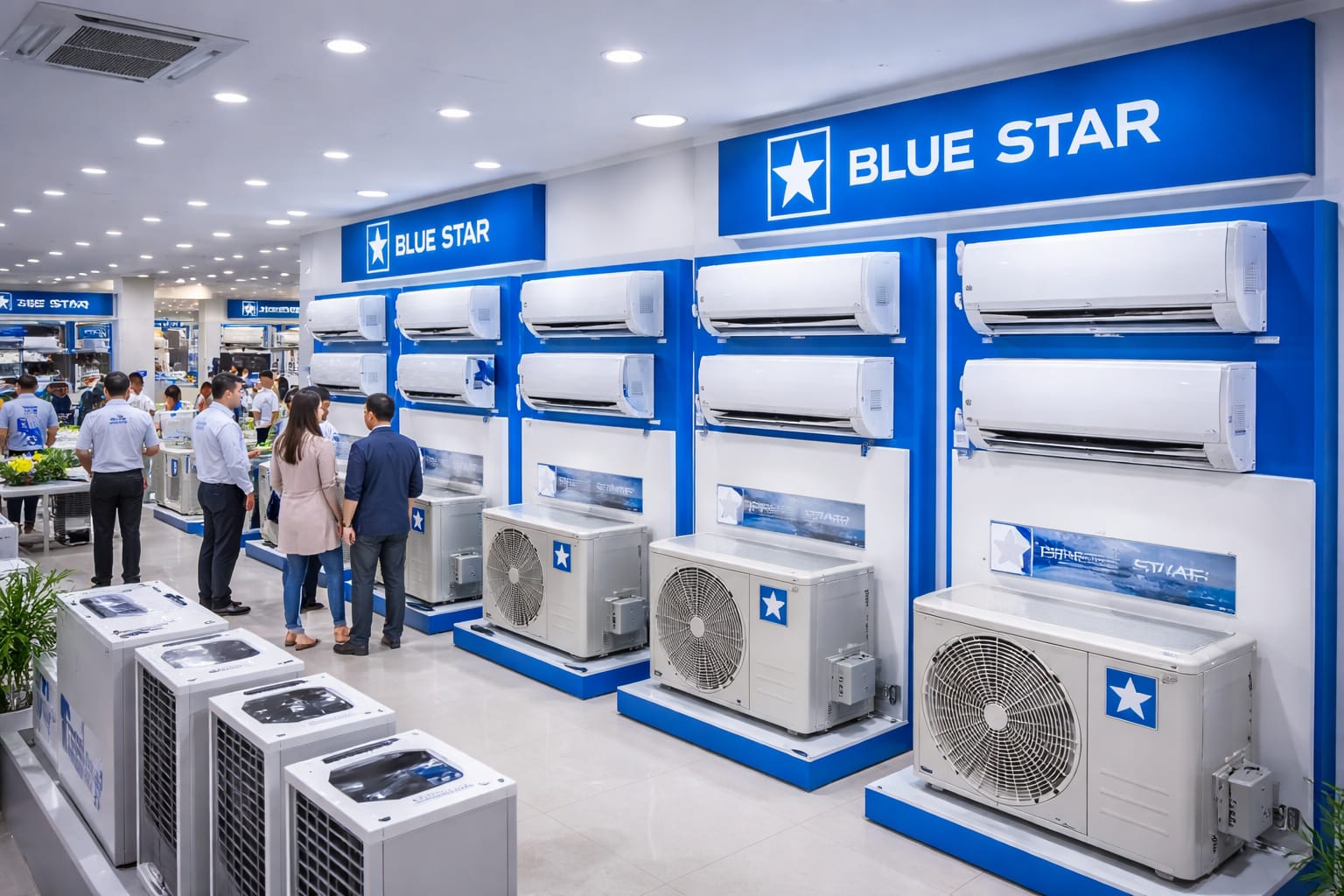
Air-conditioning major Blue Star Ltd reported a 15.2% decline in consolidated net profit to ₹102.51 crore for the first quarter ended June 30, 2026, as higher commodity prices, a weaker summer season and pressure on room air-conditioner margins offset healthy revenue growth.
The company’s consolidated revenue from operations rose 13.3% to ₹3,377.92 crore, compared with ₹2,982.25 crore in the corresponding quarter last year, supported by robust growth across its key businesses.
Operating profit (EBITDA excluding other income) declined to ₹174.95 crore from ₹199.99 crore, with EBITDA margin narrowing to 5.2% from 6.7% a year ago. Profit before tax (before exceptional items) fell 23.7% to ₹125.62 crore.
The company said margins were impacted by an unprecedented rise in commodity prices, which necessitated price increases, the delayed onset and abrupt end of the summer season, and a significant inventory build-up of older room air-conditioner models in the distribution channel.
Electro-mechanical projects drive growth
The Electro-Mechanical Projects and Commercial Air Conditioning Systems segment delivered revenue of ₹1,625.05 crore, up 15.1% year-on-year from ₹1,412.46 crore.
Segment profit stood at ₹110.22 crore, broadly in line with last year’s ₹111.62 crore, although margins moderated to 6.8% from 7.9%.
Blue Star said order inflows were led by strong investments in data centre MEP projects, while demand from commercial offices, factories and infrastructure remained subdued as higher input costs delayed project finalisation.
The company added that enquiry momentum from the data centre sector remains strong, providing confidence in medium-term growth. Commercial air-conditioning orders also remained healthy, driven by industrial, retail and healthcare customers.
Room AC business under margin pressure
The Unitary Products segment, comprising room air-conditioners and commercial refrigeration, posted 12.7% revenue growth to ₹1,689.31 crore from ₹1,499.37 crore.
However, segment profit declined sharply to ₹49.69 crore from ₹87.47 crore, with margins falling to 2.9% from 5.8%.
The company attributed the decline to a delayed summer season, which resulted in inventory accumulation across trade channels. While Blue Star attempted to pass on higher input costs through price increases, subdued market prices limited its ability to protect margins.
The company said investments in advertising, dealer incentives and consumer finance schemes helped sustain retail demand, although primary sales volumes fell short of expectations. Demand for deep freezers from ice cream manufacturers also remained weak, though the company expects recovery during the festive season.
Professional electronics business declines
Revenue from the Professional Electronics and Industrial Systems business declined 9.7% to ₹63.56 crore from ₹70.42 crore, primarily due to continued weakness in the MedTech Solutions business.
Despite lower revenue, segment profit improved to ₹9.57 crore from ₹7.62 crore, with margins expanding to 15.1% from 10.8%, supported by steady growth in the Industrial Solutions business.
Order book strengthens
Blue Star’s carried-forward order book increased 13.5% year-on-year to ₹7,764.38 crore as of June 30, 2026.
The company also reported a significantly stronger balance sheet, with a net cash position of ₹900.25 crore, compared with ₹370.92 crore a year earlier, driven by improved working capital management.
Outlook
Blue Star Ltd Chairman & Managing Director Vir S. Advani said the company delivered modest revenue growth despite multiple headwinds.
He said the strong pipeline of data centre MEP projects is expected to support growth in the coming quarters, although volatility in commodity prices and exchange rates continues to pose challenges.
Advani added that the company will focus on balancing volume growth with margins, while continuing to invest in research and development, product optimisation, cost control and maintaining a strong balance sheet. He cautioned that despite favourable medium-term prospects for the HVAC&R industry, uncertainties arising from the West Asia conflict warrant a cautious outlook for the remainder of FY27.