


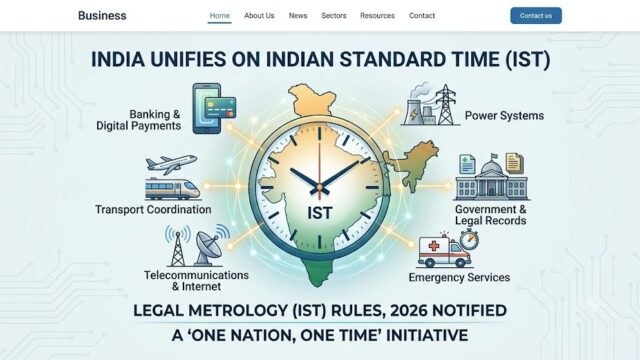
The Department of Consumer Affairs has notified the Legal Metrology (Indian Standard Time) Rules, 2026, establishing Indian Standard Time (IST) as the common time reference for legal, administrative, commercial and other official purposes across the country.
The rules were notified on August 27, 2026, and will come into force 180 days from their publication in the Official Gazette. The transition period is intended to give government departments, businesses, institutions and other organisations time to make necessary changes to their systems and processes.
The move comes as accurate time synchronisation becomes increasingly important across India’s digital and technology-driven economy. Banking and digital payments, telecommunications, railways, power systems, computer networks and government records all depend on precise time and reliable time stamps.
Common time reference
The new framework seeks to ensure that critical systems across the country use an accurate and consistent Indian Standard Time reference.
The common time standard is expected to support:
- Accurate time-stamping of banking and digital payment transactions
- Coordination of railways, airports and other transport systems
- Reliable operation of telecommunications and internet networks
- Accurate time-keeping across power systems
- Maintenance of government and legal records
- Coordination of emergency and other time-sensitive services
The initiative is part of the government’s broader ‘One Nation, One Time’ approach to establish a robust national timing infrastructure.
Indian sources for time dissemination
The government is developing infrastructure to disseminate accurate IST across the country through Indian institutions and Legal Metrology laboratories.
The rules also provide for the use of NavIC, India’s satellite navigation system, along with other approved Indian timing sources for reliable and secure dissemination of time.
At present, several systems use foreign satellite-based time sources. The development of an indigenous time-dissemination infrastructure is expected to provide additional options for critical systems and reduce dependence on external timing sources.
White Rabbit network demonstrated
As part of the One Nation, One Time initiative, a White Rabbit Technology-based Indian Standard Time Dissemination Demonstration Network was commissioned at the Regional Reference Standard Laboratory (RRSL), Bengaluru, in July 2026.
The network has demonstrated the dissemination of IST for sectors including banking, telecommunications, power, transportation and digital governance.
The Department has also demonstrated secure dissemination of IST between RRSL Bengaluru and NSE Chennai, in collaboration with CSIR-NPL, ISRO, SEBI, NSE, BSNL and other stakeholders.
White Rabbit technology enables highly precise time synchronisation over networks and can be particularly relevant to systems where accurate time stamps are critical for transactions, communications and operational coordination.
180-day transition window
The 180-day period before the rules take effect will allow stakeholders to review existing systems, undertake technical modifications and prepare for implementation.
For businesses and institutions operating time-dependent digital and physical infrastructure, the framework is expected to provide a single national reference for synchronisation and official timekeeping.
The Legal Metrology (Indian Standard Time) Rules, 2026 thus seek to establish IST as the common national time reference, strengthening the reliability and consistency of time-dependent systems as India becomes increasingly digital and interconnected.