


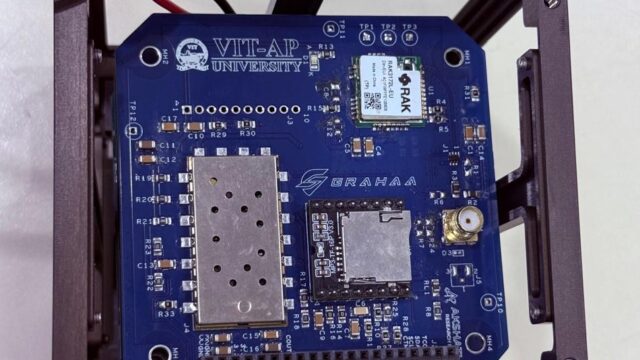
VIT-AP University has achieved a landmark in its space research journey with the successful launch of VISWA-M (VIT Satellite Wavelength Analysis Module), an experimental payload designed and developed by its students and faculty, aboard the SOLARAS nanosatellite launched on Skyroot Aerospace’s Vikram-1 orbital launch vehicle.
The payload was launched from the Satish Dhawan Space Centre (SDSC-SHAR), Sriharikota, on July 18, marking the university’s first spaceborne research mission and placing it among a select group of Indian academic institutions to have developed an active payload operating in space.
The launch coincided with Skyroot Aerospace creating history by successfully placing India’s first privately developed orbital rocket into a 450-km low-Earth orbit.
Advancing space research
VISWA-M has been developed as a compact experimental module to study the solar spectrum across multiple wavelengths using Commercial Off-The-Shelf (COTS) components and sensing systems.
The project was developed in collaboration with Bengaluru-based spacetech startup Grahaa Space (Akshath Aerospace Private Limited) under a Memorandum of Understanding signed in 2023.
Named Mission SIDDHI by Grahaa Space, the mission represents a significant milestone in VIT-AP University’s growing contribution to India’s rapidly expanding private space ecosystem.
Real-world learning for students
Beyond its scientific objectives, VISWA-M has served as a comprehensive academic project, allowing students to participate in every stage of a real satellite mission, from concept development and payload design to integration, testing and mission operations.
The mission is expected to generate valuable experience for young engineers while strengthening industry-academia collaboration in advanced space technologies.
Mission objectives
The VISWA-M payload has been designed with multiple research goals, including measuring and analysing solar radiation across multiple wavelength bands, demonstrating a cost-effective hosted payload architecture for academic satellite missions and creating foundational datasets for future research in solar spectrum monitoring and miniaturised sensing technologies.
Leadership hails milestone
VIT-AP University Vice Chancellor Dr P Arulmozhivarman described the launch as a defining moment for the institution.
“The launch of VISWA-M is a milestone for VIT-AP University and reflects our commitment to fostering research-driven education and innovation. Seeing a payload designed and developed by our students reach space demonstrates the transformative power of experiential learning, strong academic mentorship and meaningful industry collaboration,” he said.
VIT-AP University Registrar Dr Jagadish Chandra said the achievement showcased how academic excellence, research and industry collaboration can come together to deliver meaningful innovation while empowering young minds to contribute to India’s growing space capabilities.
Incubation and Entrepreneurship Cell (IIEC) Director, Innovation, Dr Ellison Mathe said the partnership with Grahaa Space had given students an unparalleled opportunity to work on a real space mission, equipping them with the technical expertise and systems-thinking skills required by the global space industry.
Student achievement
Faculty mentor Professor Mahesh Miriyala, who guided the student team behind VISWA-M, said the mission was the culmination of years of hard work.
“Being part of a mission that has placed our work in orbit is an unforgettable experience. Designing, building and testing a space payload has taught our students lessons far beyond the classroom. We are grateful to VIT-AP University management for trusting us with this incredible opportunity,” he said.