

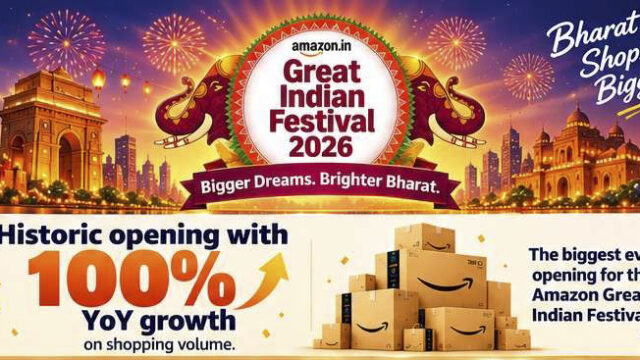
Amazon India has reported its biggest-ever opening to the Amazon Great Indian Festival 2026, with customers ordering more than twice as many products year-on-year as the e-commerce platform recorded unprecedented demand across the country.
The company said customers from every pin code in India had placed orders during the opening phase, making it the most-shopped opening day in the history of the annual shopping event. Demand spanned smartphones, consumer electronics, fashion, beauty, home appliances, kitchen products and everyday essentials.
The strong start points to robust festive-season shopping, with consumers using discounts, bank offers, exchange benefits and instalment-based payment options to purchase products across price segments.
EMI and cashback offers support demand
Amazon said one in every two customers used equated monthly instalments (EMIs) to make purchases, while one in every three units sold attracted cashback benefits.
Prime members recorded savings of more than double those in the corresponding period last year, supported by Prime-exclusive offers across a wide selection of products, the company said.
Amazon also highlighted the role of instant bank discounts, exchange offers, no-cost EMI and Amazon Pay Later in making products more affordable.
“The early trends from the Amazon Great Indian Festival 2026 have beaten our most optimistic expectations,” said Amazon India Vice President Saurabh Srivastava.
He said the company had recorded a 100% increase in products ordered and set new benchmarks in customer engagement, order volumes and delivery speed.
Premium smartphones and electronics lead upgrades
Premium Android smartphones recorded 70% year-on-year growth, with the Apple iPhone 16, Samsung Galaxy S25 Ultra, OnePlus Nord 6, Xiaomi 17 and iQOO 15R among the popular choices highlighted by Amazon.
The trend towards premium products was also visible in computing and wearables. MacBook Neo sales were 65 times higher than on a regular day, while premium wearables sold at 80 times their normal daily rate. Garmin, Apple, Samsung and Amazfit were among the leading brands in the category.
The numbers indicate strong demand for premium technology during the sale, although Amazon did not disclose absolute sales volumes or revenue generated by individual product categories.
TVs and large appliances see sharp increases
Home entertainment sales rose to 77 times the level of a regular day, according to Amazon. Televisions with screens measuring 55 inches or more accounted for 65% of all TVs sold.
High-end home theatre systems from Sony, JBL and Samsung recorded sales 100 times higher than on a regular day during the first 12 hours of the event.
Large appliances also saw substantial demand. Sales were 50 times the regular daily level, while premium front-load washing machines with capacities of 9 kg and above sold at 80 times their normal rate.
Dryers and dishwashers recorded sales 60 times higher than usual. Refrigerator sales also reached 60 times the regular daily level, with frost-free and side-by-side models from Samsung, LG, Haier and Bosch among the products driving demand. Panasonic, Hitachi and Daikin led sales in air conditioners, the company said.
Fashion sales rise sevenfold
Fashion sales reached seven times the level of a regular day, with footwear and clothing contributing to the surge.
Amazon reported that customers purchased seven pairs of shoes every second. Nike sales were 16 times the brand’s normal daily level, followed by Skechers and New Balance at 15 times, Woodland at 12 times, Hush Puppies at 11 times and Adidas at 10 times.
Demand for denim also increased sharply. Men’s bottomwear sales reached seven times the usual level, while Levi’s sales rose 30-fold and WROGN sales 13-fold. More than 1,500 pairs of jeans were sold every hour.
Women’s ethnic wear sales were four times the regular daily level, with BIBA recording 14 times its usual sales and Libas 11 times. Amazon said more than 100 kurtas were sold every minute.
Men’s shirts and T-shirts recorded sales five times higher than normal, led by Allen Solly at 12 times its usual daily level, and Louis Philippe and Peter England at 10 times.
Beauty emerges as a major category
Beauty products accounted for one in every four products purchased on Amazon.in during the first 12 hours of the sale, the company said.
Premium skincare and haircare products sold at five times their normal daily rate, with more than 150 products sold every minute. Brands highlighted by Amazon included Clinique, La Roche-Posay, CeraVe, Kérastase and Forest Essentials.
Korean beauty products recorded sales four times higher than usual, with more than 1,000 products sold every hour. Celimax, Medicube and Biodance were among the leading brands.
Luxury fragrances sold at four times their typical daily rate, with 12 products purchased every minute. Chopard, Carolina Herrera and Ralph Lauren featured among the leading brands.
Demand also extended to everyday personal-care products. Sales of soaps and shower gels reached 19 times the regular daily level, with more than 800 units sold every minute.
Health and kitchen products gain traction
Beyond electronics and personal care, Amazon reported strong demand for products associated with health, wellness and home convenience.
Air fryers and air purifiers sold at 30 times their normal daily rate, while juicers recorded sales 23 times higher and espresso machines 16 times higher.
Solara sales grew 35-fold, De’Longhi 20-fold and Philips nine-fold compared with a regular day.
The performance of premium wearables, air purifiers and kitchen appliances suggests that consumers are using the festive sale to upgrade both personal technology and household equipment.
Delivery speed becomes another competitive lever
Amazon said millions of deals were delivered within hours as customers across India began shopping during the event.
In more than 120 cities served by Amazon Now, one in every two products was delivered within minutes, highlighting the growing role of rapid fulfilment in e-commerce competition.
The opening figures provide an early indication of demand during the festive shopping season. However, order growth alone does not establish the overall financial performance of the event, as average selling prices, discount costs, cancellations and returns will also influence the final outcome.
For Amazon, the combination of higher order volumes, premium product demand, payment offers and faster delivery could help strengthen customer engagement as the Great Indian Festival progresses.