


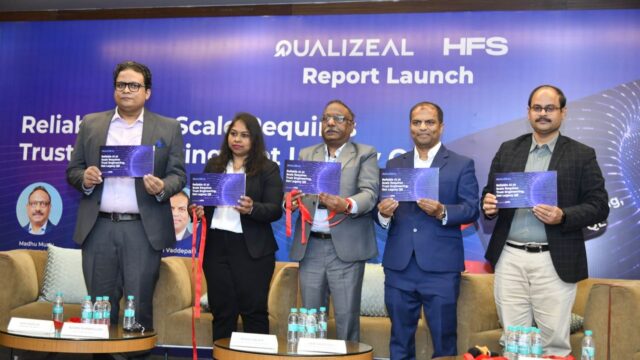
Enterprises are adopting artificial intelligence (AI) faster than they are developing mechanisms to ensure its reliability, fairness and regulatory compliance, with only 15% having purpose-built AI testing frameworks, according to a joint study by QualiZeal and HFS Research.
The study, titled ‘HFS Take 5 x QualiZeal’, surveyed 101 enterprise quality and technology leaders in the US to assess organisations’ preparedness to validate AI systems in production and examine how Quality Engineering (QE) needs to evolve in the AI era.
The findings highlight a widening gap between AI deployment and assurance capabilities. While 57% of enterprises have generative AI running in some form of production and 36% have deployed agentic AI systems, formal AI validation frameworks remain largely at the pilot stage.
Significantly, 52% of enterprises continue to test probabilistic AI systems using frameworks originally designed for deterministic software, raising questions about their ability to manage the risks associated with increasingly autonomous AI applications.
Accountability gap in AI quality
The study also points to a lack of clear accountability for AI quality within enterprises. About 37% of organisations are running AI in production without a specifically designated function responsible for its quality.
QualiZeal Co-Founder, Executive Director & CEO, Kalyan Konda said enterprises had moved AI into production much faster than they had developed the discipline to govern it.
The ownership of AI quality had evolved beyond a conventional software testing responsibility and had become a boardroom-level concern, he said.
The study underscores the need for clear accountability structures and validation mechanisms as businesses expand their AI deployments.
Accuracy does not guarantee trust
While 88% of enterprises measure AI model accuracy, considerably fewer assess other critical parameters required to establish trust in AI systems.
Only 47% measure bias and fairness, while 37% evaluate explainability. Further, just 35% can provide evidence of regulatory compliance.
The findings suggest that enterprises are concentrating more on the technical performance of AI models than on the broader requirements of responsible and accountable AI deployment.
As AI systems become increasingly integrated into business-critical operations, organisations will need to demonstrate not just accuracy but also fairness, transparency and compliance.
Quality engineering role set to expand
The transition towards AI-driven enterprise operations is also reshaping the role of quality engineers. About 82% of enterprises expect the QE function to grow significantly as AI adoption increases.
QualiZeal Co-Founder & Head of India Operations, Madhu Murty said quality engineering was undergoing a fundamental transformation, moving from assuring software to assuring intelligence itself.
The company sees AI and automation as technologies that will elevate quality engineers into trust engineers rather than replace them.
However, the study identifies a significant mismatch between the expanded responsibilities of QE teams and the resources allocated to them. Only 24% of enterprises said they had provided resources proportionate to the expanded mandate of quality engineering.
Investment in AI assurance
QualiZeal said its AI ecosystem, which includes QMentisAI and ValidAIte, is designed to help enterprises address this gap by integrating AI-led quality engineering and AI assurance into software delivery and governance processes.
HFS Research Practice Leader Hansa Iyengar said enterprises could demonstrate the accuracy of their AI systems but were far less equipped to establish that they were fair, explainable and compliant.
She emphasised that scaling AI responsibly would require organisations to appoint clear owners for AI quality, adopt testing frameworks suited to probabilistic systems and provide quality engineering teams with adequate budgets.
The study provides an assessment of enterprise readiness for AI assurance as businesses move beyond experimentation towards large-scale deployment of production-grade AI systems