


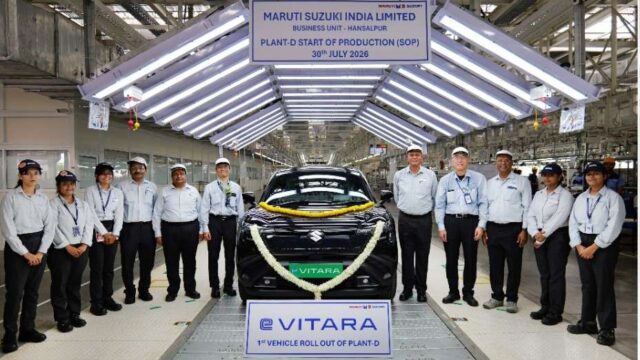
Maruti Suzuki India Ltd (MSIL) is rapidly expanding its manufacturing footprint, with installed production capacity set to rise to 3.65 million vehicles annually by the end of FY2030-31, Chairman R C Bhargava said.
In his message to shareholders in the company’s Annual Report 2026, Bhargava said two production lines have already been commissioned at Kharkhoda, with work progressing on the third line.
At Hansalpur in Gujarat, a fourth production line with an annual capacity of 250,000 units has been commissioned, taking the plant’s installed capacity to 1 million units. The facility is Suzuki’s largest manufacturing plant anywhere in the world.
Work has also commenced at a new manufacturing site in Sanand, Gujarat, where Maruti Suzuki plans to install a total production capacity of 1 million units. The proposed investment at the Sanand site is ₹35,000 crore.
“As a result of the expansion projects, our installed capacity would reach 2.9 million units at the end of FY 2026-27 and 3.65 million units at the end of FY 2030-31,” Bhargava said.
CNG demand accelerates
Maruti Suzuki is also witnessing strong demand for its CNG-powered vehicles.
CNG vehicle sales increased 22% to 7.46 lakh units in FY2025-26. The momentum has strengthened further in the current financial year, with the company selling 2.2 lakh CNG cars in the first quarter, representing a 58% year-on-year growth.
Maruti Suzuki has set a target of selling 9 lakh CNG cars during FY2026-27, reflecting the growing consumer preference for cleaner and more economical mobility solutions.
Rail freight gets bigger role
The company is also increasing its reliance on railways to transport vehicles from its manufacturing facilities.
The proportion of cars transported by rail stood at 26.5% in FY2025-26 and is expected to increase to 28% in FY2026-27.
Bhargava said the railway siding at the Manesar plant has been functioning well, delivering both cost savings and greater logistical convenience. A similar railway siding is also planned at Kharkhoda.
Apart from reducing logistics costs, rail transportation helps lower the carbon footprint associated with vehicle movement and carries a lower risk of damage during transit, he said.
Nearly half of India’s car exports
Maruti Suzuki has strengthened its position in India’s vehicle export market and now accounts for nearly 50% of cars exported from India, according to Bhargava.
Japan has emerged as the company’s third-largest export market, while Maruti Suzuki expects export volumes to increase from the previous year’s level despite geopolitical challenges in West Asia.
EV gains traction
Maruti Suzuki’s electric vehicle strategy is also gaining momentum.
The company has introduced an electric SUV, which has received a positive response in the market. It has exported 40,873 units of the EV so far, while domestic sales stood at 5,648 units during the first quarter of the current financial year.
Bhargava said the company has been comfortably meeting all regulatory requirements and expects to continue doing so in the future.
Small-car recovery strengthens
Maruti Suzuki has also seen a sharp improvement in retail sales following the implementation of the new GST rates on September 22, 2025.
The company’s retail sales grew 17% in the second half of FY2025-26, while it ended March with around 1.9 lakh pending bookings due to inadequate manufacturing capacity for some of the models in demand.
Bhargava said the capacity constraint was partly a consequence of adjustments made over several years to respond to the decline in small-car sales and the rapid growth of the SUV segment.
The company is now addressing the issue by ensuring that its new production lines are flexible enough to manufacture different platforms and models as market requirements change.
Sales growth outpaces industry
The strategy is already beginning to show results.
In the first quarter of FY2026-27, Maruti Suzuki’s sales grew 38%, significantly ahead of the 28% growth recorded by the overall industry.
The recovery in small cars has also gained momentum. While small-car sales grew 17% in the second half of FY2025-26, growth accelerated to 35% in the first quarter of FY2026-27, as the company was able to produce more of the models customers were seeking.
The combination of expanding capacity, flexible manufacturing, rising CNG demand, stronger exports and growing EV adoption is expected to give Maruti Suzuki greater room to respond to changing consumer preferences while strengthening its position in India’s increasingly competitive passenger vehicle market.