


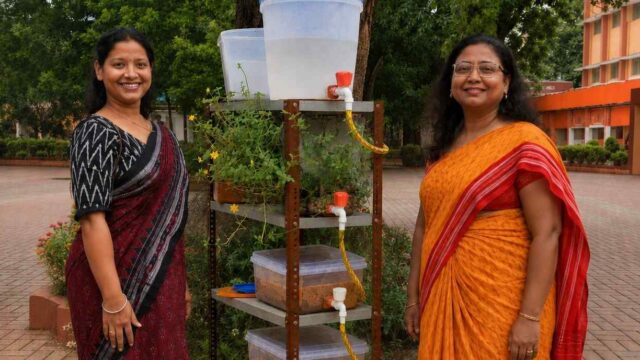
National Institute of Technology Rourkela (NIT Rourkela) has developed a low-cost biological wastewater treatment system designed to tackle pollution generated by the dairy industry.
Developed by researchers from the institute’s Civil Engineering department, the multi-layered treatment process combines aquatic plants, earthworms, microbial activity and hydroponic filtration to reduce organic pollution and prevent clogging issues commonly faced in conventional treatment systems.
Addressing dairy pollution challenge
India’s dairy industry generates billions of litres of wastewater daily during the production of products such as cheese, paneer and yogurt.
This wastewater contains high levels of fats, proteins and carbohydrates, resulting in elevated Chemical Oxygen Demand (COD), a key indicator of organic pollution in water bodies. High COD levels reduce dissolved oxygen in water, posing a threat to aquatic ecosystems.
The research team noted that conventional treatment technologies such as membrane filtration often face frequent clogging and fail to effectively address the organic load challenge.
Patent secured for technology
The wastewater treatment system was developed by NIT Rourkela’s Civil Engineering Department led by Prof. Kakoli Karar Paul along with research graduate Dr. Pragyan Das.
The research team has secured a patent titled ‘Method and System for Treating Dairy Wastewater’ for the technology.
How the system works
The treatment process operates through multiple layers, with each stage performing a dedicated purification function.
The first layer uses a worm-active reactor containing earthworms and aquatic plants. The earthworms break down organic waste into smaller particles and improve oxygen levels, enabling microbes to degrade pollutants more effectively.
The second layer uses sand filtration to remove suspended solids, while the third layer deploys fly ash pellets to absorb pollutants and reduce phosphorus compounds.
In the fourth stage, wastewater flows through a gravel bed where aerobic microbes eliminate residual organic contaminants.
The final stage uses a hydroponic treatment chamber where plant roots oxygenate the water and support beneficial microbial biofilms that further purify the wastewater.
Low-cost and scalable model
Paul said, “In a lab scale setup, the developed system costs about Rs. 10,000 and is capable of treating 30 liters of dairy wastewater per day which can be further increased as per requirement.” The researchers said the treated water retains phosphate nutrients, making it suitable for agricultural irrigation purposes.
Resource recovery benefits
Pragyan Das said, “Through this system, we have developed an affordable wastewater treatment solution which can be easily used in regions where access to large-scale treatment infrastructure is either unavailable or limited. With our natural treatment approach, the treated wastewater can be directly reused in agricultural purposes, thus reducing environmental impact and resource-efficient waste management practices.”
The research team added that the aquatic plants used in the treatment process can also be utilised as cattle feed or processed further for biogas and biodiesel production, enabling additional resource recovery benefits.