


India’s space sector is witnessing an unprecedented transformation, driven by sweeping policy reforms that have opened the doors for private participation and positioned the country as an emerging global space powerhouse.
The successful launch of Skyroot Aerospace’s Vikram-1, India’s first privately developed orbital launch vehicle, marks a defining milestone in the country’s rapidly evolving commercial space ecosystem and underscores the impact of the Government’s reform agenda.
The Indian Space Policy 2023 has opened the entire space value chain, from satellite manufacturing and launch services to space-based applications and downstream services, to private companies, encouraging innovation, investment and entrepreneurship.
Startup ecosystem takes off
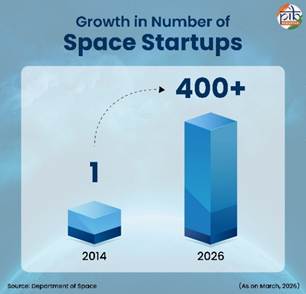
The reforms have triggered a remarkable surge in private participation. India’s space startup ecosystem has expanded from just one startup in 2014 to more than 400 startups in 2026, reflecting growing investor confidence and a vibrant innovation landscape.
The country’s space economy, currently valued at around $8.4 billion, is projected to grow nearly five-fold to $40-45 billion by 2030, with an ambitious target of reaching $100 billion by 2040.
The Government expects sustained policy support, enabling regulations and stronger public-private partnerships to make India a global hub for space technology, manufacturing, innovation and commercial space services.
Indian Space Policy opens new opportunities
The Indian Space Policy 2023 marked a watershed moment by allowing Non-Government Entities (NGEs) to participate across the entire space value chain.
The policy seeks to accelerate technological innovation, attract private investments and encourage international collaborations for peaceful space exploration while creating a competitive and inclusive ecosystem.
IN-SPACe drives industry participation
The Indian National Space Promotion and Authorisation Centre (IN-SPACe) has emerged as the single-window regulator for India’s private space sector, providing authorisations, regulatory support and access to ISRO’s infrastructure, technologies and technical expertise.
As of June 2026, IN-SPACe has registered more than 4,500 organisations, issued 133 authorisation and signed 106 memoranda of understanding.
The agency also facilitated $150 million in investments into Indian space startups during calendar year 2025, while the top 10 startups secured confirmed order books worth the same amount.
In addition, IN-SPACe has enabled 118 technology transfer agreements and 189 Joint Project Implementation Plans (JPIPs), Technology Partnership Agreements (TPAs) and Business Partnership Agreements (BPAs).
These initiatives are accelerating commercialisation of space technologies and strengthening industry collaboration.
₹500 crore fund to commercialise space technologies
To support indigenous innovation, IN-SPACe has launched the ₹500 crore Technology Adoption Fund (TAF).
The scheme provides financial assistance to help startups, MSMEs and industries transform early-stage space technologies into commercially viable products.
Under the programme startups and MSMEs can receive funding of up to 60% of project cost, large industries are eligible for up to 40% funding, financial assistance is capped at ₹25 crore per project.
NSIL expands India’s commercial footprint
The Indian Space Policy 2023 also strengthened the role of NewSpace India Limited (NSIL) as ISRO’s commercial arm.
NSIL is responsible for manufacturing and procuring space systems, offering end-to-end commercial space solutions, supporting PSLV productionisation, transferring small satellite technologies and marketing Indian space products globally.
The company has reported a tenfold increase in revenue over the years, reflecting the growing commercialisation of India’s space programme.
As of December 2025, more than 70 technology transfer agreements had enabled ISRO-developed technologies to reach industry.
By July 2026, NSIL had launched 141 satellites, comprising 138 international/customer satellites and three Indian satellites, reinforcing India’s credentials as a reliable global launch service provider.
Liberalised FDI policy attracts global investors
The Government has also liberalised foreign direct investment (FDI) norms to attract global capital and advanced technologies into the space sector.
The revised policy allows up to 74% automatic FDI in satellite manufacturing and operations, up to 49% automatic FDI in launch vehicles and spaceports and up to 100% automatic FDI in manufacturing satellite components and subsystems.
The reforms are expected to accelerate investments, facilitate technology transfer, strengthen collaborative research and improve the ease of doing business in India’s rapidly expanding space economy.