


An Indian Institute of Technology Madras (IIT Madras) faculty member has contributed to an international research breakthrough demonstrating how electrical current can drive the rotation of a single molecule and how the resulting motion can, in turn, enhance electrical conduction at the atomic scale.
The findings, published in Nature, a leading peer-reviewed scientific journal, could advance fundamental understanding of molecular machines and help inform the future development of nanoscale electronic components whose electrical properties can be controlled through molecular motion.
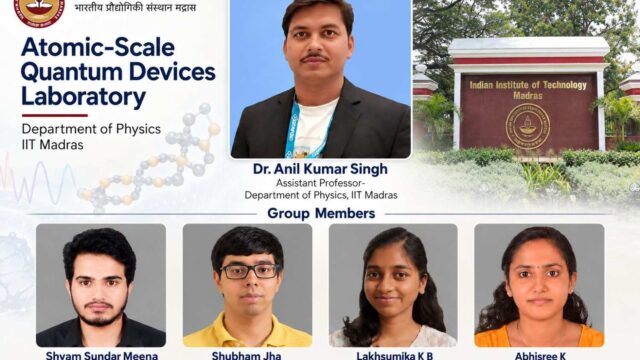
Dr. Anil Kumar Singh, Assistant Professor in the Atomic-Scale Quantum Devices Laboratory in the Department of Physics at IIT Madras, is a corresponding author and the principal experimental contributor to the study.
The research brought together scientists from India, Israel, Germany, Denmark and China, combining experimental investigations with molecular synthesis, theoretical modelling and quantum-mechanical calculations.
Molecular motion and electrical current
Molecular machines are structures that perform specific functions in response to stimuli such as light, chemicals or electricity. Although such machines play essential roles in biological systems, understanding how electrical current can drive controlled molecular motion, and how that motion subsequently affects current flow, has remained a scientific challenge.
The researchers demonstrated a mechanism in which electrical current drives the directional rotation of a single molecule, while the rotation facilitates the passage of electrons through it.
IIT Madras, Assistant Professor in the Department of Physics, Dr. Anil Kumar Singh, said molecular motion could do more than simply result from electrical transport.
As the molecule rotates, it accesses configurations with higher electrical conductance that are less accessible when it remains stationary. Demonstrating this feedback between rotation and electrical conduction in a single-molecule junction advances understanding of how mechanical motion and electronic function can be coupled at the atomic scale, he explained.
Molecular rotor inspired by the Archimedean screw
The researchers drew inspiration from the Archimedean screw, a traditional device used to lift water that can also operate in reverse as a turbine.
They investigated whether a similar relationship between electrical current and rotational motion could be demonstrated using a single molecule.
The team developed a molecular rotor based on helicene, a molecule with a spiral structure resembling a tiny screw. Using a technique called a mechanically controllable break junction, the researchers suspended a single helicene molecule between two gold electrodes.
When voltage was applied, the electrical current drove the molecule through a cyclic sequence of configurations.
In all 122 cases in which the direction of the transitions could be determined, the researchers observed the same cyclic sequence. Reversing the voltage polarity reversed the sequence, demonstrating electrical control over the direction of molecular motion.
The team also observed a sharp increase in electrical current beyond a threshold voltage. Experimental measurements supported by theoretical calculations indicated that the molecule transitioned from moving stepwise between preferred orientations to continuous rotation.
During this rotation, the molecule passed through configurations that allowed electrons to flow more readily, increasing the current through the intact molecular junction by up to approximately 100-fold.
The researchers found that gently stretching or compressing the junction could also alter the onset of this enhancement by changing the effective pitch of the helical molecule.
Applications remain at the research stage
The findings could inform the development of molecular-scale switches, current-modulating elements and systems designed to promote directional transport near surfaces.
However, the researchers cautioned that the work represents a fundamental proof of principle rather than a technology ready for practical deployment.
The experiments were conducted at a cryogenic temperature of 4.2 kelvin, approximately minus 269 degrees Celsius. Further research will be required to establish reliable operation under practical conditions.
Future investigations could examine whether molecular rotors can be controlled using circularly polarised light or spin-polarised electrical currents, potentially expanding opportunities for optical and spin-dependent control of molecular motion.
International research collaboration
Dr. Singh designed and conducted the single-molecule break-junction experiments during his research tenure at the Weizmann Institute of Science in Israel. He also analysed the experimental data and prepared the associated figures.
The research involved collaborators from institutions across five countries, bringing together expertise in experimental physics, molecular synthesis and theoretical calculations.
The study lists Anil Kumar Singh, Fabian Pauly, Michael Pittelkow, Jing-Tao Lü, Per Hedegård and Oren Tal as corresponding authors.
The findings provide a scientific foundation for further investigations into experimental quantum transport and molecular electronics, areas in which Dr. Singh is pursuing an independent research programme at IIT Madras.