

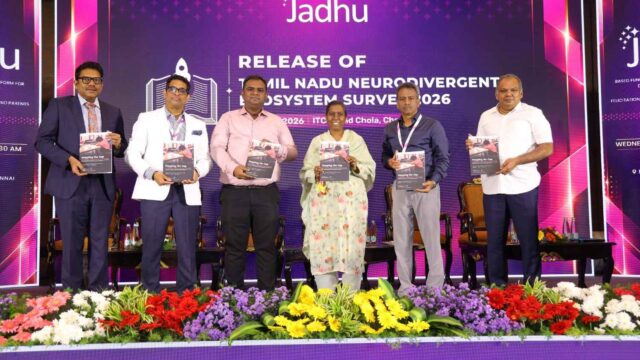
Chennai-based Rewin Health has launched an artificial intelligence (AI)-powered daily life-skills platform for differently abled children, teenagers and adults, alongside a ₹3 crore initiative to provide free access, support and therapy sessions to 500 families across Tamil Nadu.
Called Jadhu, the platform combines AI-personalised daily programmes, virtual reality (VR)-based simulations of real-world situations and real-time physiological monitoring to help users develop everyday skills and improve their ability to participate independently in daily life.
The launch comes against the backdrop of significant gaps in disability care in Tamil Nadu. Rewin Health’s statewide study, Mapping the Gap: Differently Abled Care in Tamil Nadu 2026, covering 2,027 respondents and 27 government interviews, found that 61% of families wait more than a year for a diagnosis, while 74% face severe cost pressures.
The study also found that 72% of families lack access to structured therapy and 83% of parents report that the gains made through therapy do not translate into everyday life.
Bridging the gap between therapy and daily life
Jadhu is designed for people with Autism Spectrum Disorder (ASD), attention-deficit/hyperactivity disorder (ADHD), oppositional defiant disorder (ODD) and other learning differences.
The platform seeks to extend the benefits of clinic-based therapy into homes by enabling structured, personalised practice in everyday situations. It is designed to complement, rather than replace, clinical diagnosis and professional therapy.
“Jadhu exists because too many families in Tamil Nadu are told to wait — for a diagnosis, for a therapy slot, for a professional to have the time to see their child,” said Rewin Health Founder and Chief Executive Officer, Vijay Karunakaran.
The study’s findings point to the need for consistent practice beyond clinical settings, he said, adding that Jadhu provides 60 minutes of guided, personalised practice at home each day and gives therapists objective data on the learner’s progress between sessions.
The platform has been clinically validated in collaboration with eight medical institutions, special schools and care organisations, according to the company.
AI personalisation and virtual reality
Jadhu generates personalised daily sessions following an initial assessment. Its programme comprises two 30-minute blocks drawn from a library of more than 200 therapeutic games.
The foundational programme focuses on nine skill domains: cognition, communication, activities of daily living, social participation, visual perception, motor development, focus and attention, sensory regulation, and learning and academics.
An additional set of modules enables users to practise everyday activities, including grocery shopping, travelling by bus, dining out and following classroom routines. The company says the platform includes more than 40 such real-world scenarios, allowing users to rehearse situations in a controlled environment.
The technology is designed to operate across different devices and settings. Users can access daily practice through a smartphone or tablet, while a low-cost Jadhu Viewer enables 360-degree experiences using a smartphone. More immersive VR sessions using Meta Quest headsets are available at partner clinics, hospitals and schools when recommended by a therapist.
The flexible delivery model is intended to expand access to structured practice without requiring every family to invest in specialised hardware.
Wearable technology tracks anxiety
Jadhu also incorporates a wearable sensor that monitors physiological signals in real time to identify signs of rising anxiety.
When stress levels increase, the platform adjusts the pace of a session and guides users through calming and breathing exercises. The feature is intended to help users develop emotional self-regulation skills.
Parents and caregivers can access session updates, weekly summaries of activity and anxiety trends, and monthly reports covering progress across the nine skill domains. The platform also provides a six-month comparison of progress.
Therapists can access the same underlying data through a companion application, allowing them to track performance across home, school and clinical settings.
₹3 crore community initiative
As part of its launch, Rewin Health will provide free access to Jadhu along with support and therapy sessions, to 500 differently abled families across Tamil Nadu. The company has valued the initiative at ₹3 crore and said it will fund the programme entirely from its own resources.
Rewin Health is also working with healthcare institutions, special schools and government bodies to integrate digital therapeutics into mainstream support systems.
The initiative addresses a persistent challenge in disability care: ensuring that skills acquired during structured therapy can be practised consistently in everyday environments.
By combining personalised digital programmes, simulated real-world experiences and progress monitoring, Jadhu aims to make such practice more accessible to families while providing therapists with additional information to support individual care plans.