


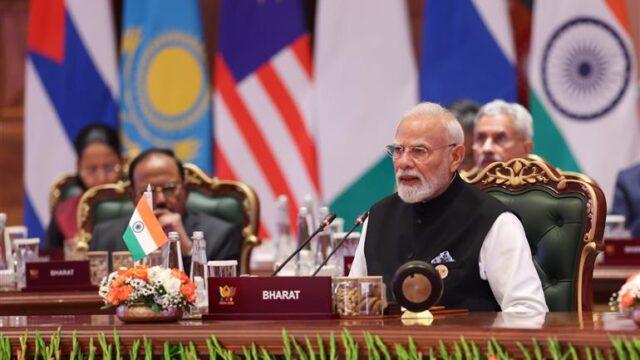
Prime Minister Narendra Modi has called for a more ambitious role for BRICS in shaping the global order, saying the grouping must convert its internal unity and consensus into concrete outcomes on the global stage as it enters its 20th year.
Addressing the BRICS Summit, Modi said India’s chairship had followed a people-centric and humanity-first approach, with resilience, innovation, cooperation and sustainability as its key priorities. More than 350 meetings were organised across nearly 30 cities during India’s chairship.
BRICS enters a new phase
Modi described the 20th anniversary of BRICS as a “coming of age” moment for the grouping, comparing it with the stage in human life when capabilities begin to be channelled towards greater responsibility.
Over two decades, BRICS has established a distinct identity globally by respecting different perspectives and moving forward through consensus, he said.
The Prime Minister said the next 20 years should be guided by a new and ambitious agenda, beginning with stronger institutional mechanisms within BRICS.
Continuity mechanism proposed
Since the BRICS chairship changes every year, Modi proposed a BRICS Continuity and Implementation Mechanism to ensure that institutional momentum is not disrupted between successive presidencies.
The mechanism, operating through the BRICS Troika, would systematically follow up on initiatives and outcomes.
He also proposed a secure digital repository that could record the nodal point responsible for each decision, its implementation timeline and its status.
From a pyramid to a partnership
Modi said the existing structure of global governance resembles a “pyramid”, with power and decision-making concentrated at the top while countries at the bottom are affected by decisions but have limited influence over their formulation.
He said the Global South is today “in the front row of global crises, but in the back row of decision-making.”
The Prime Minister called for this “pyramid of privilege” to be transformed into a “platform of partnership”, where every country has a voice and a stake in global decision-making.
To advance this objective, he proposed that BRICS formulate 10 proposals for global governance reform, with the aim of developing them into a BRICS Reform Roadmap by the next Summit.
Three priorities for global reform
Modi said the roadmap should focus on three areas, Representation, Responsiveness and Rule-making.
On representation, he said reform of the UN Security Council could no longer be delayed. Text-based negotiations should be linked to a clearly defined timeline and concrete outcomes, he said.
He also called for greater alignment between voting power, leadership positions and policy priorities in financial institutions and today’s economic realities.
Countries driving global economic growth, he said, should have an appropriate role in shaping global economic governance.
Faster response to global crises
On responsiveness, Modi said global institutions can earn humanity’s trust only when they provide effective solutions to global challenges.
He called for greater focus on the speed, scale and last-mile impact of collective responses.
As one practical initiative, he proposed a Seafarers Emergency Support Network, which could connect maritime authorities and missions of the countries concerned. Such a network could facilitate distress alerts, medical assistance, communication with families and evacuation support for seafarers facing difficulties.
Global South must become rule-shapers
Modi also highlighted the importance of equal participation in developing future global rules, particularly as AI, cyberspace, outer space, biotechnology and critical technologies reshape economies and societies.
He proposed using BRICS to provide young diplomats and policymakers from the Global South with negotiation skills, practical training and legal expertise, enabling them to participate more effectively in shaping international rules.
The objective, he said, should be to transform the Global South from “rule-takers into rule-shapers.”