


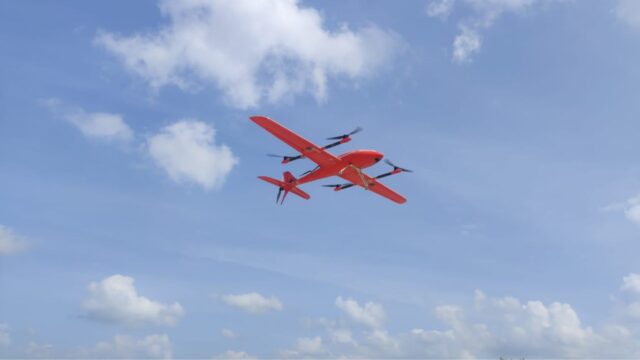
Drogo Aerospace has secured Directorate General of Civil Aviation (DGCA) type certification for its JK 250e fixed-wing vertical take-off and landing (VTOL) unmanned aerial vehicle (UAV), taking the company’s tally of certified platforms to six and strengthening its portfolio of indigenous drone technologies for defence and training applications.
Designed to meet the intelligence, surveillance and reconnaissance (ISR) requirements of the Indian armed forces, the JK 250e combines the flight efficiency of a fixed-wing aircraft with the operational flexibility of vertical take-off and landing. The configuration allows the UAV to operate without a conventional runway, making it suitable for deployment in challenging field conditions.
The certification comes as India seeks to expand domestic capabilities in defence manufacturing and reduce dependence on imported unmanned systems. Indigenous UAV platforms that combine surveillance capabilities with operational flexibility are increasingly relevant to military requirements, particularly in environments where conventional launch and recovery infrastructure may be unavailable.
Designed for sustained surveillance
The JK 250e has an endurance of two to three hours and is designed to support sustained surveillance, situational awareness and other ISR operations. Its hybrid fixed-wing and multirotor configuration seeks to combine the endurance advantages of fixed-wing flight with the ability to take off and land vertically.
Drogo Aerospace delivered JK 250e UAVs to the Indian Army earlier this year. The latest certification is also expected to support UAV operator training and the development of indigenous training capabilities.
According to the company, the certification marks a step towards expanding the use of domestically developed UAV technology across defence operations and training programmes.
Expanding the certified UAV portfolio
Drogo Aerospace chief Yeshwanth Bonthu said the JK 250e was the only UAV in India with a hybrid fixed-wing and multirotor configuration to receive DGCA type certification for training purposes.
He described the certification as an important milestone in the development of indigenous UAV technology for defence and training applications.
Bonthu said the company would continue to work towards international standards while contributing to the development of India’s defence and aerospace capabilities.
With six certified platforms, Drogo Aerospace is expanding its portfolio in a segment where certification, operational reliability and the ability to meet specialised military requirements are important considerations. The JK 250e’s certification and its delivery to the Indian Army provide a foundation for the company to pursue further opportunities in defence UAV deployment and operator training.
The extent to which these capabilities translate into larger orders and wider adoption will depend on operational requirements, procurement decisions and the company’s ability to scale production and support services.