


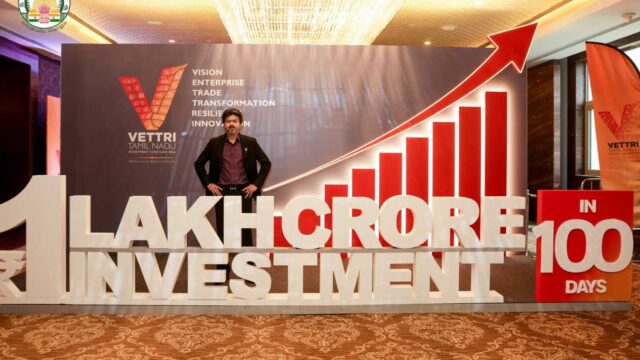
Tamil Nadu’s latest investment conclave has witnessed 97 companies committing ₹67,452 crore investments and 1,06,998 jobs.
But the more important story behind the numbers is the changing composition of investment. The commitments announced at the VETTRI Tamil Nadu Investment Conclave 2026 point to a state attempting to move beyond its traditional manufacturing strengths into semiconductors, advanced engineering, data centres, clean energy, electric mobility, aerospace and defence, life sciences and Global Capability Centres (GCCs).
The conclave, held in Chennai in the presence of Tamil Nadu Chief Minister C. Joseph Vijay, saw 97 companies exchange MoUs covering projects across the state. Of these, 25 companies are making their first investment in Tamil Nadu, potentially widening the state’s industrial base.
The scale of the announcements was independently corroborated by Reuters, which reported that Tamil Nadu signed 97 agreements worth ₹674.52 billion, with foreign investors accounting for 16 projects worth about ₹150.5 billion.
The headline number is only part of the story
Alongside the 97 MoUs, the government said foundation stones were laid for eight projects involving ₹4,476 crore and 5,074 jobs, while five projects worth ₹2,676 crore and 1,550 jobs were inaugurated.
Another 15 completed projects, involving ₹777.74 crore, were also inaugurated. These included works by SIPCOT, TIDCO, Tamil Nadu Paper Mills and Tamil Nadu Industrial Housing Private Limited.
The government also distributed appointment orders to 20 individuals selected for positions in nine companies, while seven institutional agreements were exchanged covering areas such as trade, MSME development, drone training, technology transfer and semiconductor skilling.
Taken together, the numbers show an attempt to present investment not merely as future commitments, but as a pipeline extending from MoU to construction to operational projects.
That distinction matters because an MoU is a commitment to pursue an investment, not the investment itself. The real test for the new administration will therefore be how quickly these commitments translate into land acquisition, financial closure, construction, production and actual jobs.
Manufacturing remains the backbone
Despite the widening sectoral spread, manufacturing remains at the heart of the investment story.
Titan’s ₹1,000-crore plan for Hosur, which is expected to create 1,200 jobs, will expand facilities for premium watches, jewellery and automation equipment for its electronics business.
Lucas TVS, one of India’s established automotive and EV component manufacturers, plans to invest ₹2,500 crore across multiple facilities.
France’s Saint-Gobain has committed ₹2,000 crore towards a new greenfield plant in Krishnagiri and expansion of its Kancheepuram facility. Japan’s YKK, the world’s largest zipper and fastening-products manufacturer, plans to invest ₹1,651 crore in Tiruvallur.
Germany’s Daimler India Commercial Vehicles has separately proposed an additional ₹4,000-crore investment in Tamil Nadu to strengthen BharatBenz manufacturing, product development and the wider commercial vehicle ecosystem.
These announcements reinforce Tamil Nadu’s established advantage in automotive and engineering manufacturing while adding higher-value activities around electronics, automation and advanced components.
Data, chips and digital infrastructure emerging as new pillars
Perhaps the most significant structural shift is the increasing prominence of technology-intensive sectors.
The government’s list includes semiconductors, data centres, GCCs and advanced engineering, indicating that Tamil Nadu wants to capture a greater share of the investment moving into digital infrastructure and technology-enabled manufacturing.
Super Micro Computer, a US-based server manufacturer ranked No. 292 on the Fortune 500, is set to begin server assembly operations in Chennai. Reuters also identified Super Micro Computer among the major foreign investors announced at the conclave.
This is strategically important. Data centres and server manufacturing create demand not only for physical infrastructure but also for power, cooling, networking, electronics, engineering services and skilled manpower.
The opportunity for Tamil Nadu is to build an ecosystem around these investments rather than treating each project as an isolated facility.
Clean energy and EVs move closer to the mainstream
The investment mix also reflects the accelerating transition towards cleaner mobility and energy.
The Hinduja Group plans to invest ₹2,500 crore across renewable energy, electric mobility, automotive, financial services, battery charging infrastructure and digital mobility solutions.
A key component is the proposed development of more than 200 MW of renewable energy projects through Hinduja Renewables Energy, covering solar, wind and battery technologies.
The EV ecosystem is also receiving fresh capital. Beyond Lucas TVS, the conclave-linked investment pipeline includes electric mobility, battery and charging infrastructure projects, strengthening Tamil Nadu’s position in an industry where vehicle manufacturing increasingly depends on localised component and energy ecosystems.
The first-100-days message
The conclave has also become an important marker for the new administration.
Industries, Investment Promotion and Commerce Minister S. Keerthana said the announcements would take cumulative investment commitments during the government’s first 100 days beyond ₹1 lakh crore, with the potential to generate more than 1.2 lakh jobs.
Her formulation, roughly ₹1,000 crore of committed capital for every day in office, provides the political headline. The economic significance, however, lies in whether the government can convert this pace of commitment into a sustained pipeline of actual investment.
Tamil Nadu has a substantial industrial base to build upon. Chennai and its surrounding manufacturing belt host major automotive and electronics operations, while Hosur, Coimbatore, Tiruppur, Sriperumbudur, Oragadam and southern districts have developed specialised industrial clusters.
Reuters described Chennai as a major manufacturing hub, with operations of companies including Hyundai, Renault, TVS Motor and Apple suppliers such as Foxconn and Tata Electronics.
From attracting investment to executing investment
This is where the next phase becomes more demanding.
Tamil Nadu has demonstrated its ability to attract large investment proposals. The challenge now is conversion.
The state will have to provide land, power, water, logistics connectivity and skilled manpower while ensuring that regulatory clearances move at the speed required by globally mobile capital.
The concentration of investment in sectors such as semiconductors, data centres, EVs and advanced manufacturing also raises the bar. These projects require specialised infrastructure and technical talent, not merely industrial land.
There is another issue: global competition.
Tamil Nadu is competing with Karnataka, Telangana, Maharashtra, Gujarat, Andhra Pradesh and Uttar Pradesh for the same pools of capital and technology. Companies deciding where to locate new plants increasingly compare not just incentives, but ecosystem depth, logistics, power reliability, talent availability, supplier networks and speed of execution.
Jobs matter as much as investment
The promised 1,06,998 jobs is arguably more important than the ₹67,452-crore investment headline.
However, the quality and timing of these jobs will determine the economic impact. Semiconductor engineering, aerospace, advanced manufacturing, data centres and GCCs can generate higher-value employment than conventional assembly operations, but they also require significantly more specialised skills.
The seven institutional agreements covering semiconductor skilling, technology transfer, drone training and MSME development therefore assume significance.
If these initiatives are aligned with the new investments, Tamil Nadu can potentially create a virtuous cycle: investment attracts skills, skills attract technology, technology deepens the supplier ecosystem, and the stronger ecosystem attracts more investment.
A diversified investment map
The geographical spread is equally noteworthy.
The announcements extend beyond Chennai to Hosur, Krishnagiri, Kancheepuram, Tiruvallur and southern districts, including Tirunelveli, Thoothukudi and Virudhunagar.
That could help Tamil Nadu address one of the perennial challenges of industrialisation — ensuring that investment and employment are not excessively concentrated around Chennai.
The proposed renewable-energy projects, for instance, are looking at catchment areas including Tirunelveli, Thoothukudi, Virudhunagar, Madurai and Coimbatore.
What the ₹67,452 crore really means
The most constructive way to read the conclave is not simply that Tamil Nadu has attracted ₹67,452 crore.
It is that the state is attempting to upgrade the nature of its industrial economy.
The traditional pillars, automobiles, engineering, textiles and manufacturing, remain firmly in place. Around them, a second layer is emerging: semiconductors, electronics, data infrastructure, EVs, renewable energy, aerospace and defence, life sciences and technology services.
That diversification can make Tamil Nadu’s industrial economy more resilient and increase the value captured from each investment.
But the scoreboard has now changed.
MoUs are the beginning, not the finish line.
The next milestones should be the number of projects that reach financial closure, the amount of capital actually deployed, factories that begin production, exports generated and jobs that materialise.
If the government can convert a meaningful proportion of today’s commitments into operating assets over the next few years, the VETTRI Tamil Nadu Investment Conclave 2026 could prove to be more than a large investment announcement. It could mark the beginning of a new phase in Tamil Nadu’s industrial evolution — from a manufacturing powerhouse to a broader technology, energy and advanced-industrial hub.