


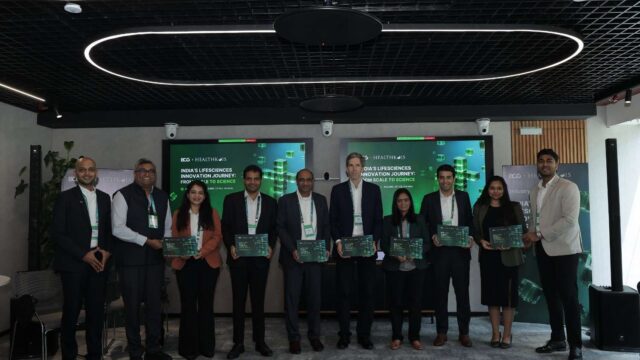
India is at a crucial stage in its pharmaceutical innovation journey, with the next five years likely to determine whether the country evolves from a global manufacturing powerhouse into a leading originator of breakthrough medicines, according to a joint report by Boston Consulting Group (BCG) and HealthKois.
The report, titled “Built on Scale, Turning to Science: India’s Pharma and Life Sciences Innovation Opportunity”, highlights India’s growing capabilities in drug discovery, advanced therapeutics and artificial intelligence while identifying critical gaps in research funding, clinical trials and innovation capital that need to be addressed.
Based on 30 in-depth interviews with founders, pharmaceutical executives, investors and ecosystem leaders, along with analysis of patents, venture capital investments and global innovation data, the report concludes that India has built a strong foundation to become a globally competitive life sciences innovation hub.
Innovation momentum gathers pace
The report notes that India has already produced more than 10 novel drug assets over the past decade, signalling a shift from being predominantly a generic medicines manufacturer to an innovation-driven pharmaceutical ecosystem.
Private equity and venture capital investments in the pharmaceutical sector more than doubled over five years to $731 million in FY26, while the number of biotech startups increased from around 1,500 to 2,400.
India’s drug discovery pipeline has also expanded by about 1.5 times to over 1,095 programmes across 195 companies.
Pharmaceutical patent families originating from India rose sharply from approximately 716 in 2015 to 2,995 in 2024, increasing the country’s share of global pharma patents from 3-4% to nearly 10%.
According to the report, Indian companies are increasingly moving beyond generics and biosimilars to develop and commercialise original therapies for global markets.
Strong enablers driving innovation
The report identifies four key factors supporting India’s innovation ecosystem. These include nearly $5 billion in government funding for early-stage and translational research, stronger collaboration between academia and industry, regulatory reforms that have reduced drug development timelines from 180-270 days to 60-120 days, and the creation of shared R&D and manufacturing ecosystems such as Genome Valley and C-CAMP.
The report also cites successful examples of laboratory research translating into commercial products, including BIRSA 101, India’s first indigenous CRISPR-based therapeutic, and NexCAR19, an indigenous CAR-T therapy priced at nearly one-tenth the cost of comparable international treatments.
Multiple pathways to global markets
Indian pharmaceutical companies are adopting diverse strategies to compete globally. Small molecule therapeutics account for around 49% of PE/VC investments and 58% of active patents, while AI and digital therapeutics attract about 17% of private capital.
The report highlights several landmark international partnerships, including Glenmark Pharmaceuticals’ licensing agreement with AbbVie, valued at $700 million upfront with milestone payments of up to $1.2 billion.
Other examples include collaborations involving Almirall, Astria Therapeutics, ImmunoACT, Cipla, and Peptris, reflecting increasing global confidence in India-origin science.
India has a unique competitive advantage
According to the report, India’s greatest strengths lie in cost-disruptive innovation, data-driven precision medicine and science-based platform development.
Clinical trials in India cost 50-60% less than in the United States, while the country’s large patient pool, diverse genetic profile and strong scientific talent provide a significant competitive advantage.
Rather than competing solely on frontier science, India can differentiate itself by combining affordability, data and scientific expertise, the report says.
Structural gaps remain
Despite the encouraging progress, the report cautions that several structural challenges continue to hinder India’s innovation ambitions.
Although India accounts for nearly 15% of the global disease burden, it conducts only around 4% of global clinical trials.
Annual pharmaceutical R&D expenditure stands at $2-3 billion, compared with $70-75 billion in the United States.
The report also points to a shortage of specialist venture capital, noting that only 10-15% of Indian venture capital firms possess deep pharmaceutical and biotechnology expertise, compared with nearly 60% in the US.
Shift from replication to origination
Boston Consulting Group India & Southeast Asia Managing Director and Senior Partner Priyanka Aggarwal said India’s pharmaceutical industry is witnessing a fundamental transformation.
“We are seeing a shift from replication to origination, and from process excellence to scientific discovery. Realising this potential will require specialist biotech capital, stronger academia-industry partnerships, faster regulatory pathways and addressing the talent gap in R&D,” she said.
BCG Partner Abhinav Anand said Indian companies are demonstrating multiple pathways to global success, citing examples such as Zydus, Glenmark and other innovators developing globally competitive therapies.
Patient capital will be critical
HealthKois Co-Founder and Managing Partner Charles Janssen said India-origin science is increasingly attracting global pharmaceutical companies.
“We are seeing India-origin science licensed by global pharma majors, while indigenous CAR-T therapies are reaching patients at a fraction of international costs. Patient capital that understands the science will determine whether India creates a handful of successes or builds a sustainable innovation ecosystem,” he said.
HealthKois Co-Founder and General Partner Ajay Mahipal said India is uniquely positioned to combine scientific talent, cost competitiveness and data-driven healthcare innovation.