


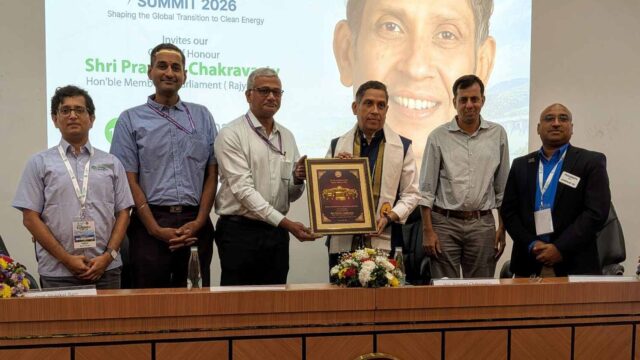
The ability to store renewable energy rather than merely generate it will determine India’s next phase of energy transition, with Tamil Nadu potentially emerging as a major clean energy exporter to South Asia, according to discussions at the fifth Energy Summit 2026 organised by IIT Madras.
Addressing the summit on November 18, Praveen Chakravarthy, Member of Parliament (Rajya Sabha), highlighted energy storage as a critical missing link in Tamil Nadu’s renewable energy ecosystem, arguing that the state’s long coastline could eventually facilitate electricity exports to neighbouring South Asian countries through undersea cables.
Tamil Nadu is already a significant wind and solar energy producer. However, the intermittent nature of renewable power makes storage technologies essential to ensure uninterrupted supply and improve the utilisation of generated electricity.
“Generation is no longer a problem, the question moves towards storage,” Chakravarthy said, pointing out that Tamil Nadu is the country’s second-largest wind energy producer.
Reducing dependence on imported battery technology
Chakravarthy also flagged India’s dependence on imported lithium-ion batteries as a strategic vulnerability, particularly as the country seeks to expand electric mobility and renewable energy infrastructure.
He said India imported lithium-ion batteries worth $5 billion last year, with 80% of the imports coming from China.
The dependence on imported battery technology risks replacing one form of external energy dependence with another, he argued, referring to India’s historical reliance on imported oil.
He urged researchers and industry participants at the summit to develop indigenous technologies that could reduce this dependence.
Chakravarthy also suggested that Tamil Nadu’s uninterrupted coastline could provide an opportunity to export renewable electricity that cannot be stored domestically, provided the necessary storage and transmission technologies are developed.
The proposition places energy storage, grid integration and cross-border electricity transmission at the centre of Tamil Nadu’s longer-term clean energy strategy.
Five-day summit brings industry and academia together
The Energy Summit 2026 is being organised by The Energy Consortium, a Centre of Excellence at the Indian Institute of Technology Madras (IIT Madras), from November 17 to 21 at the institute’s Chennai campus.
The event brings together stakeholders from industry, academia and government to discuss technological and policy challenges associated with India’s energy transition.
The summit opened on November 17 with pre-conference workshops, followed by plenary sessions, panel discussions, technical presentations, student talks and poster sessions.
IIT Madras Director Prof. V. Kamakoti, said energy generation, storage and distribution were increasingly important across sectors ranging from artificial intelligence and agriculture to advanced manufacturing.
He said research, development and commercialisation of technologies supporting renewable energy systems would be critical to achieving India’s energy objectives.
Advanced batteries, hydrogen and AI in focus
The technical discussions on November 18 focused on advanced batteries and hydrogen systems, alongside artificial intelligence and digitalisation in energy systems.
The subsequent sessions will examine sustainable energy and environmental systems, the water-energy nexus, integrated systems, smart power systems and microgrids.
These themes reflect the growing importance of integrating renewable energy generation with efficient storage, intelligent distribution networks and industrial applications.
IIT Madras, Faculty Head, The Energy Consortium, Prof. Satyanarayanan Seshadri said the summit had evolved over five years into a platform for industry and academia to jointly address emerging energy challenges.
This year’s discussions cover advanced batteries and hydrogen, AI and digitalisation, sustainable energy and environmental systems, water-energy systems, and smart power systems and microgrids.
Focus on deep-tech commercialisation
Beyond technology discussions, the summit is also seeking to strengthen the commercialisation ecosystem for emerging energy solutions.
The pre-conference workshops covered AI for climate and energy systems, agentic systems for engineering and research, deep-tech commercialisation and science entrepreneurship, besides an IIT Madras-Deakin University workshop.
A separate focus on developing a nuclear design and manufacturing ecosystem among micro, small and medium enterprises (MSMEs) is intended to encourage wider industrial participation in the emerging energy technology landscape.
Energy Summit 2026 Convener Prof. Nitin Muralidharan said the event had created opportunities for young researchers through student presentations and poster sessions, alongside workshops aimed at translating research into practical applications.
The summit will conclude with discussions on smart power systems and microgrids, invited talks, student presentations, poster sessions and a valedictory ceremony.