


Indian Institute of Management Lucknow (IIM Lucknow) has welcomed the inaugural cohort of its first undergraduate programme, the Bachelor of Science (BS) in Artificial Intelligence and Business Analytics (AI & BA), marking a significant expansion of its academic offerings into the fast-growing field of artificial intelligence.
The first batch of 60 students began their four-year journey on August 17, 2026, and is scheduled to graduate in 2030. The programme is aimed at developing a new generation of professionals equipped with capabilities spanning AI, business analytics and management, with a broader objective of contributing to India’s long-term growth.
The programme was launched at the Bharat Bodhan AI Conclave 2026 in New Delhi as part of the India AI Impact Summit 2026.
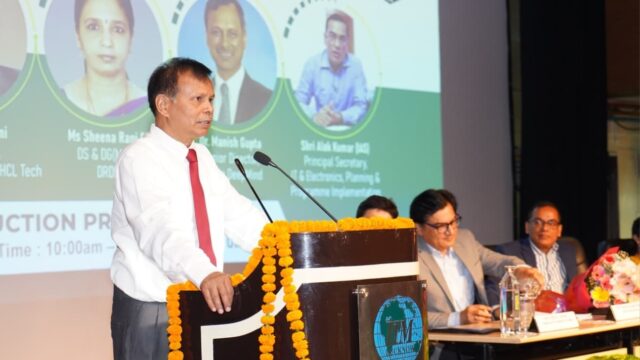
The inaugural session brought together senior representatives from the technology, AI research, defence and public policy sectors, including Sandeep Saini, Business Head, Sovereign AI Business, HCLTech, Sheena Rani R, DS & DG (MCC), DRDO, Dr Manish Gupta, Senior Director, Google DeepMind, and Alok Kumar (IAS), Principal Secretary, IT and Electronics, Planning and Programme Implementation. Gupta joined the event virtually.
The session was also attended by Prof M P Gupta, Director, IIM Lucknow, Prof Sanjay K Singh, Dean (Programmes), Prof Suresh Kumar Jakhar, Chairperson, BS (AI & BA) and Prof Pradeep Kumar, Chairperson, Admissions.
Focus on India’s AI ambitions
IIM Lucknow Director Prof M P Gupta said the programme was designed as part of a larger vision to bring together technology, artificial intelligence and management to contribute to India’s growth.
“The entire programme is strongly built with the idea to create a very definite impact in India’s growth story,” Prof. Gupta said.
He also urged the first batch to recognise the significance of being the programme’s inaugural cohort and to use their time at IIM Lucknow to develop capabilities that could create meaningful impact in the years ahead.
Alok Kumar, Principal Secretary, IT and Electronics, Planning and Programme Implementation, highlighted the innovative nature of the programme and said the growing importance of AI would make courses of this nature increasingly sought after.
He told the students that the programme could become significantly more competitive in the coming years, making their position in the inaugural cohort particularly significant.
Building AI and management capabilities
IIM Lucknow Dean (Programmes) Prof Sanjay K Singh encouraged students to make use of the diverse learning opportunities available at the institute, both inside and outside the classroom.
He emphasised that while AI and technology can enhance individual capabilities, students must continue to develop critical and independent thinking.
Prof Suresh Kumar Jakhar, Chairperson, BS (AI & BA), noted that the inaugural cohort was beginning its academic journey at a time when AI was undergoing rapid transformation.
While several generations of students are expected to follow, he said the distinction of being the first cohort would remain unique to the 2026 batch.
Drawing on a Buddhist story highlighting the value of dhyana, or focused attention, Prof. Jakhar urged students to cultivate deep focus, continuous learning and effective use of their time as they navigate an increasingly technology-driven environment.
Graduating into India’s AI ecosystem
The BS (AI & BA) programme is positioned at the intersection of artificial intelligence, data-driven decision-making and business management. The inaugural cohort is expected to graduate in 2030, entering a business environment in which AI is likely to play an increasingly central role across industries.
For IIM Lucknow, the undergraduate programme represents an expansion into an area that is expected to be critical to India’s technology and economic development.
The institute sees the capabilities developed through the programme as contributing to the broader Viksit Bharat@2047 vision by building AI and business talent capable of supporting India’s growth over the coming decades