


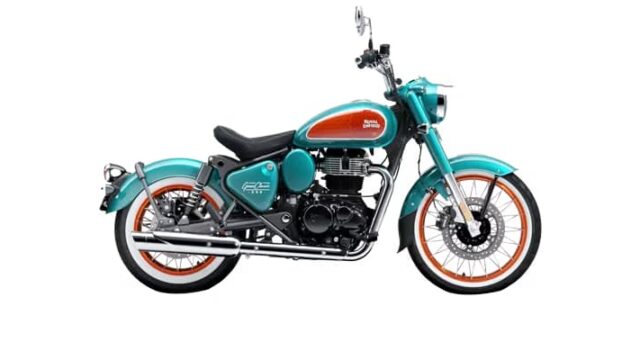
Royal Enfield’s record-breaking FY26 performance is more than just a strong sales year for the iconic motorcycle maker. The company’s ability to cross 1.2 million annual sales for the first time, while simultaneously entering electric mobility and expanding manufacturing capacity, points to a structural transformation underway at the Chennai-based brand.
The company sold 12,27,977 motorcycles in FY26, up 22% year-on-year, marking its second consecutive year of crossing the one-million-sales milestone. Domestic sales rose 23% to 11,07,343 units, while exports grew 20% to 120,634 units. Royal Enfield also recorded its best-ever fourth quarter sales at 3,13,811 units.
Beyond volumes
For years, Royal Enfield occupied a niche segment in the Indian motorcycle market, catering primarily to leisure and lifestyle riders. The FY26 numbers indicate the brand has now moved firmly into scale territory without diluting its premium positioning.
The company’s sustained double-digit growth comes at a time when the broader two-wheeler industry has been witnessing uneven demand recovery, particularly in the entry-level commuter segment. Royal Enfield’s continued expansion suggests India’s premium motorcycle category is becoming increasingly mainstream.
The success also underlines the company’s ability to widen its customer base beyond traditional Bullet and Classic loyalists. Models such as the Hunter 350, Guerrilla 450 and Himalayan have helped the brand appeal to younger urban buyers, adventure riders and first-time premium motorcycle customers.
Capacity expansion reveals long-term confidence
Perhaps the clearest signal of Royal Enfield’s future ambitions lies in its manufacturing expansion plans.
The company announced a ₹958 crore brownfield investment at its Cheyyar facility in Tamil Nadu, which will increase annual production capacity from 14.6 lakh units to 20 lakh units. This is besides the company’s plan to set up a Greenfield plant in Andhra Pradesh at an investment of ₹,500 crore.
The scale of the investment indicates Royal Enfield is preparing for sustained long-term demand rather than short-term cyclical growth. It also reflects confidence in both domestic premiumisation trends and export opportunities.
The capacity addition becomes especially important as the company broadens its portfolio across multiple sub-segments, including urban roadsters, adventure motorcycles, cruisers and electric mobility products.
Electric entry without abandoning heritage
Royal Enfield’s entry into electric mobility through the Flying Flea C6 marks one of the company’s most strategically significant moves in recent years.
Unlike many legacy manufacturers that rushed into EVs with commuter-focused products, Royal Enfield appears to be positioning Flying Flea as a lifestyle-oriented urban mobility brand. The company is attempting to preserve its design-led identity while adapting to changing mobility preferences.
The Flying Flea C6 combines retro-inspired styling with connected technology and lightweight architecture, targeting urban riders rather than mass-market electric commuters.
The approach could help Royal Enfield avoid direct competition with high-volume electric scooter makers while creating a differentiated premium electric motorcycle category.
The brand-building strategy around Flying Flea also reflects Royal Enfield’s increasingly global aspirations. The motorcycle was showcased across multiple Indian cities as well as London, while its Red Dot Award 2025 recognition under the ‘Design Concept’ category adds international credibility.
International business becoming strategically important
Royal Enfield CEO B Govindarajan highlighted Brazil and other overseas markets as key growth priorities.
Exports crossing 120,000 units demonstrate that Royal Enfield is gradually evolving from an India-centric manufacturer into a global mid-size motorcycle brand.
International markets are strategically important for multiple reasons. They reduce dependence on domestic demand cycles, improve brand visibility and potentially support stronger margins in premium segments.
Royal Enfield’s focus on community rides, gaming collaborations and cultural partnerships also suggests the company is increasingly positioning itself as a lifestyle brand rather than merely a motorcycle manufacturer.
Quality and brand strength add to competitive advantage
The company’s operational gains are being complemented by improving brand perception and dealer relationships.
Royal Enfield ranked highest in overall two-wheeler initial quality in the J.D. Power 2025 study and secured the top position in the FADA Dealer Satisfaction Survey. The company was also ranked third among the World’s Strongest Automobile Brands in the Brand Finance Automotive Industry 2026 report.
These recognitions matter because premium motorcycle buyers are increasingly influenced by ownership experience, service quality and brand identity rather than pure pricing considerations.
The combination of strong sales growth, expanding global presence, electric mobility entry and manufacturing investments suggests Royal Enfield is entering a new phase where it is no longer just India’s dominant mid-size motorcycle maker, but an emerging global premium mobility brand with multi-category ambitions.