


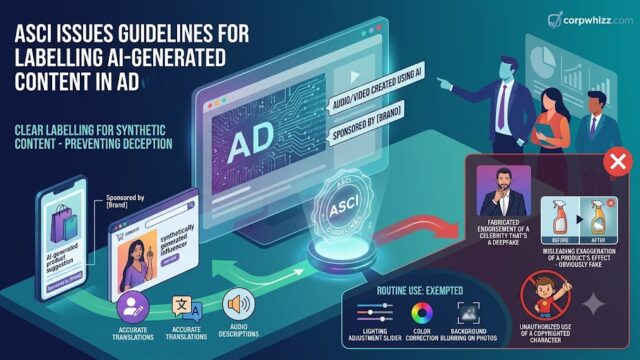
The Advertising Standards Council of India (ASCI) has issued guidelines for the responsible labelling of synthetically generated content (SGC) in advertising, setting out when brands must disclose the use of AI-generated or AI-enhanced content and the circumstances in which such content is prohibited.
The Guidelines for Responsible Labelling of Synthetically Generated Content in Advertising follow stakeholder consultations on the draft guidelines released in May. They will come into effect three months from the date of publication.
Misleading AI content remains prohibited
ASCI said advertisements using SGC must comply with the ASCI Code, irrespective of whether an AI label is used. Prohibited practices include fabricated endorsements or testimonials, misleading exaggeration of product results or features, presenting non-existent locations as real, unauthorised use of copyrighted works and using deepfakes or an individual’s likeness without consent.
The guidelines also seek to address situations where synthetic content could create unrealistic expectations, exploit vulnerable consumers or present unsafe situations.
When AI disclosure becomes mandatory
Labelling will be mandatory when SGC materially influences consumer decisions and the absence of disclosure could mislead consumers.
This includes synthetic influencers and ambassadors, replication of a real person’s likeness or voice with consent for personalised messaging, fabricated events or settings that could affect consumers’ understanding of a product or service, and demonstrations involving products that do not yet exist.
AI-generated sound effects that are central to a product’s features, such as sound demonstrations for headphones, will also require disclosure. Paid or sponsored AI-generated product suggestions must specifically carry the label “Sponsored by [Brand]”.
Routine AI use does not require disclosure
ASCI said disclosure is not required when synthetic content does not materially affect a consumer’s ability to make an informed choice.
Routine editing such as colour correction, lighting adjustments, noise reduction and minor blemish removal is excluded. Decorative or ambient elements, obvious fantastical effects, administrative and text-based applications such as generating advertising copy, and accessibility uses including subtitles, translations and accurate audio descriptions also do not require labelling.
Labels must clearly inform consumers
Where disclosure is required, brands can use labels such as “Audio/Video created using AI” or “Audio/Video enhanced using AI”, including labels provided by advertising platforms. Alternative wording may also be used if it accurately communicates the nature of the synthetic content.
“AI use in advertising is evolving rapidly, and our approach must evolve with it while keeping the consumer at the centre,” said Advertising Standards Council of India (ASCI) Secretary General and CEO Manisha Kapoor.
She said the guidelines establish practical transparency requirements where a consumer’s understanding of an advertisement could be adversely affected without disclosure, while clarifying that an AI label does not make an otherwise misleading advertisement acceptable.
ASCI said all advertisements using SGC will continue to be assessed against the ASCI Code in its entirety.