

India’s economic linkages with the European Union (EU) have deepened over the years. The total bilateral merchandise trade between the two trading partners stood at $ 136 billion in FY25, having risen from $ 99 billion in FY19. India’s exports to the EU have recorded encouraging growth in the last decade. While India’s exports to the world grew at a CAGR of 5.9% during FY16-25, exports to the EU have risen by an upbeat 8.7%, says a Care Ratings report.
India’s imports from the EU have grown at a CAGR of 5% over the last decade, compared to 7.4% for India’s world imports. In terms of the trade balance, India’s trade surplus with the EU was recorded at $ 15.9 billion in FY25, up from $ 13.6 billion in FY22 . Prior to FY22, the trade balance between India and the EU was in a marginal deficit.
In FY25, the EU accounted for 17.3% in India’s total exports, next to the US, which had a share of 19.8%. Over the past decade, India’s exports to the EU have trended upward, with its share increasing to 17.3% (FY25) from close to 14% a decade ago. Within the EU, India’s largest export destinations are the Netherlands and Germany, with shares of 5.2% and 2.4%, respectively, in total merchandise exports. The EU has also emerged as India’s key import partner, with an 8.3% share of total imports, following China (15.8%), Russia (8.9%) and the UAE (8.8%). India’s largest trading partner for imports within the EU is Germany, accounting for 2.6% of total merchandise imports.
India-EU Trade Deal
The conclusion of the India–EU trade deal marks a significant milestone both economically and geopolitically. The integration of these two large, diverse, and complementary economies is expected to create large opportunities for trade and investment. The India–EU Free Trade Agreement is set to provide a decisive boost to India’s labour- intensive sectors such as textiles, apparel, leather, footwear, marine products, gems and jewellery, handicrafts, engineering goods, and automobiles, helping them integrate more deeply into global value chains. Apart from trade, the agreement is expected to enhance cooperation across technology, climate action, digital trade, and business mobility.
India to Gain Greater Access to the European Goods Markets: 70.4% of tariff lines, covering 90.7% of India’s exports (in value terms), will receive immediate duty elimination for key labour-intensive sectors such as textiles, leather and footwear, tea, coffee, spices, sports goods, toys, gems and jewellery, and select marine products. A further 20.3% of tariff lines, accounting for 2.9% of exports, will be granted zero-duty access over a period of three to five years for items including certain marine products, processed foods, and arms and ammunition. Additionally, 6.1% of tariff lines, representing 6% of exports, will enjoy preferential market access through tariff reductions for products such as poultry, preserved vegetables, and bakery items, or via Tariff Rate Quotas (TRQs) for cars, steel, and specific shrimp and prawn products.
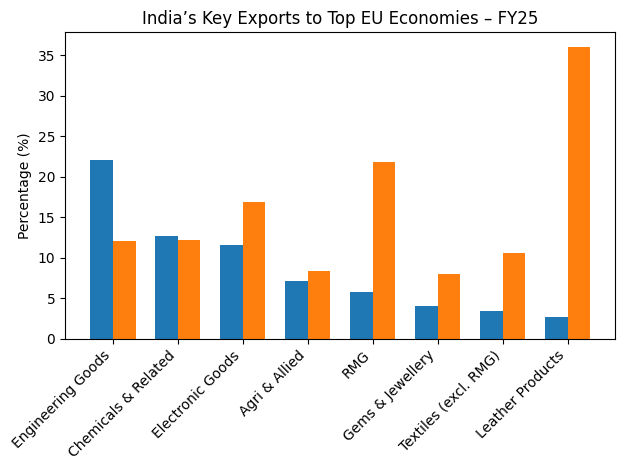
Among specific item-wise exports to the EU, engineering goods (export share of 22% to the top EU economies. They are set to gain from the preferential market access. Engineering goods exports currently face tariffs as high as 22%. The trade deal also ensures zero duty on 97.5% of India’s chemical export basket by value, eliminating duties of up to 12.8%. Among labour-intensive exports, jewellery exports, currently subject to tariffs of up to 4%, are set to gain preferential access to 100% of trade value.
Textiles and clothing exports are set to gain zero-duty access across all tariff lines, reducing tariffs by up to 12%. This will bring India at par with its key competitors in this segment, such as Bangladesh, Turkey, Vietnam, Pakistan, and Cambodia, that already enjoy duty-free access to the EU market. Moreover, India will gain a 12% duty advantage over China, which currently holds the largest market share of nearly 30% in the EU’s RMG imports.
Furthermore, exports of leather products are set to gain from tariff elimination. While leather exports account for just 2.7% in India’s total exports to the EU, the sector is of significance since its exports to the EU alone account for 36% of India’s total leather exports . However, India has not been exempted from the EU’s Carbon Border Adjustment Mechanism (CBAM), which imposes charges on high‐carbon goods like steel, cement, fertilisers, and electricity.
EU’s Gains from Greater Access to Indian Markets: From the EU’s perspective, India will immediately remove tariffs on 30% of EU imports, and overall duties on over 90% of EU goods will be cut or phased out, potentially saving EU exporters about EUR 4 billion annually. Most products that previously faced steep levies – including machinery (up to 44 %), chemicals (up to 22%), and pharmaceuticals (up to 11 %) – will see those charges largely disappear. Taxes on EU wines and spirits entering India will also be markedly lowered.
The agreement also opens India’s automotive market to more EU vehicles. Import duties on most cars from the EU priced above EUR 15,000 will be significantly reduced under annual quotas for internal combustion and electric vehicles. However, electric cars will not benefit from the duty cuts for the first five years to safeguard Indian EV manufacturers’ investments.
Safeguard for Sensitive Sectors: While the trade deal is expected to provide market access for more than 99% of India’s exports by trade value, it aims to preserve policy space for sensitive sectors, safeguarding India’s developmental priorities. The deal seeks strategic safeguards for India’s sensitive sectors, such as dairy, cereals, poultry, soymeal, and certain fruits and vegetables. The EU will also retain tariffs on certain sensitive agricultural and food products, such as beef, sugar, rice, chicken meat, milk powders, honey, bananas, soft wheat, garlic and ethanol.
Support for Services Exports: Under the FTA, India has secured broader and deeper commitments from the EU across 144 services subsectors, including IT/ITeS, professional services, education, and other business services. This encompasses a wide range of service sectors and provides Indian service suppliers with a stable, enabling regulatory environment in the EU market. In return, India’s market access offer covers 102 service subsectors aligned with key EU priorities, including professional, business, telecommunications, maritime, financial, and environmental services. These commitments will provide EU companies with a predictable, transparent framework for investing in India and delivering innovative services. Together, these reciprocal commitments establish a mutually beneficial framework that is expected to accelerate trade in services.
Easier Mobility of Human Resources: The FTA provides a predictable framework for the temporary entry and stay of professionals, including Business Visitors, Intra-Corporate Transferees, Contractual Service Suppliers, and Independent Professionals. A comprehensive mobility framework facilitates the movement of employees of Indian companies established in the EU, along with their dependents, across all service sectors. Indian firms supplying services under contract will gain access to 37 subsectors, including IT, business, and professional services. In comparison, Independent Professionals will receive assured market access in 17 subsectors, including IT, R&D, and higher education, expanding opportunities for Indian talent and knowledge- based trade.
Easier Trade and Intellectual Property Protection: The FTA enhances cooperation on Sanitary and Phytosanitary Measures (SPS) and Technical Barriers to Trade (TBT) matters by facilitating the recognition of conformity assessment results, enabling the equivalence of SPS measures based on technical justification, and allowing localised responses to pest and disease outbreaks. Furthermore, the FTA reinforces intellectual property protections in line with TRIPS, covering copyright, trademarks, industrial designs, trade secrets, plant varieties, and the enforcement of IPRs.
Conclusion
The trade deal reinforces the vision of a “multipolar” global world and strengthens global integration at a time of heightened risk from rising US tariff uncertainties and geopolitical tensions. While implementation and ratification may take time, the deal is expected to cushion the domestic economy against growing global protectionism and rising external headwinds over the medium to long term. This deal may serve as a benchmark for India’s negotiations of future trade deals. Broadly, India’s and the EU’s export items are complementary; however, domestic players in some sectors need to gear up for heightened competition. However, certain aspects, such as the EU’s Carbon Border Adjustment Mechanism, remain a key monitorable going forward.