


The Reserve Bank of India (RBI) has released draft amendment directions aimed at tightening norms governing the conduct of commercial banks in the recovery of loans and the engagement of recovery agents.
The proposed changes seek to enhance borrower protection, improve transparency and curb harsh recovery practices while strengthening accountability of banks for the actions of their agents.
Under the draft titled “Conduct of Regulated Entities in Recovery of Loans and Engagement of Recovery Agents”, the RBI has mandated that banks put in place a comprehensive policy governing loan recovery, engagement of recovery agents and possession of secured assets.
The policy must clearly define eligibility and due diligence criteria, permissible activities, a Code of Conduct, performance evaluation standards, audit and inspection mechanisms, and penal actions against non-compliant agents. It must also cover recovery procedures in cases involving the demise of borrowers or guarantors.
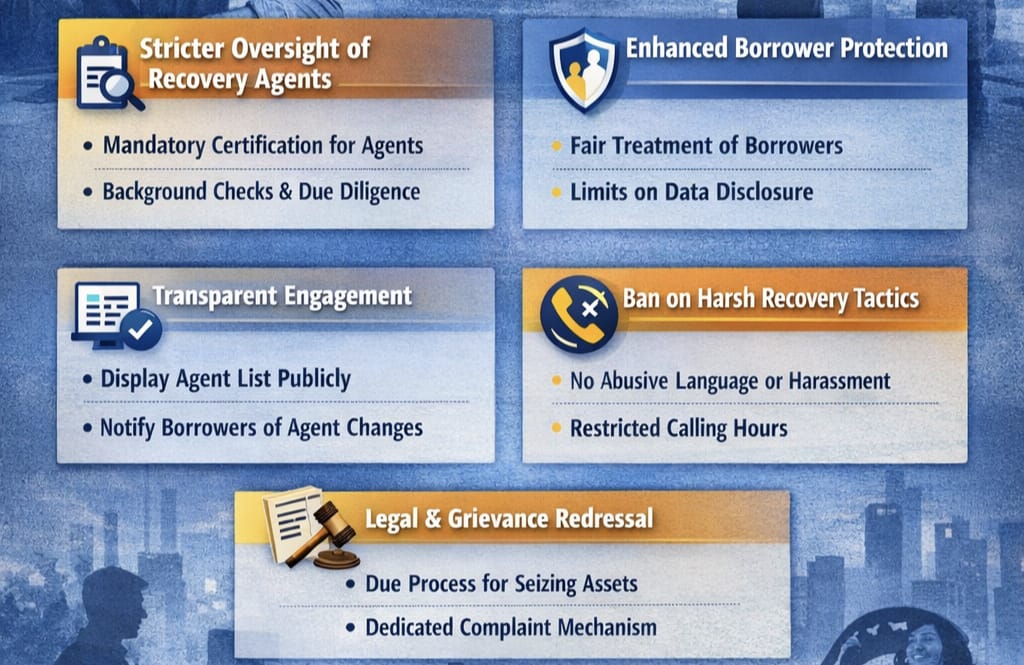
The central bank has emphasised enhanced due diligence and accountability in the engagement of recovery agents. Banks will be required to ensure that recovery agents and their employees undergo antecedent verification at the time of engagement and periodically thereafter, in line with RBI’s outsourcing risk management directions.
Further, all recovery agents must be certified by the Indian Institute of Banking and Finance (IIBF) after completing prescribed training programmes.
To improve transparency, banks must prominently display an updated list of empanelled recovery agents across all customer-facing channels, including branches, websites and mobile applications. In case of termination of a recovery agent, banks must publicise the same to prevent borrowers from dealing with unauthorised agents.
Borrowers must also be formally informed of the details of the recovery agent assigned to their case, and any subsequent change must be immediately communicated.
The draft directions place strong emphasis on fair treatment of borrowers. Banks will need mechanisms to identify borrowers facing repayment stress and provide guidance on available recourse.
Disclosure of borrower information to recovery agents must be strictly limited, with safeguards against misuse of customer data. Where a grievance is pending, banks are barred from assigning recovery agents unless complaints are found to be frivolous.
RBI has also proposed strict norms around recovery practices, including mandatory recording of calls, documentation of call frequency, and adherence to prescribed contact hours between 8 am and 7 pm.
Recovery agents are prohibited from using abusive language, making excessive or anonymous calls, harassing borrowers or their families, or making misleading representations.
On enforcement of security, the draft requires banks to follow due legal process, provide adequate written notice, and clearly outline possession and auction procedures in loan agreements. Legal action cannot be the first resort for recovery.
The RBI has also mandated dedicated grievance redressal mechanisms for recovery-related complaints, reinforcing its focus on responsible lending and ethical recovery practices across the banking system.