


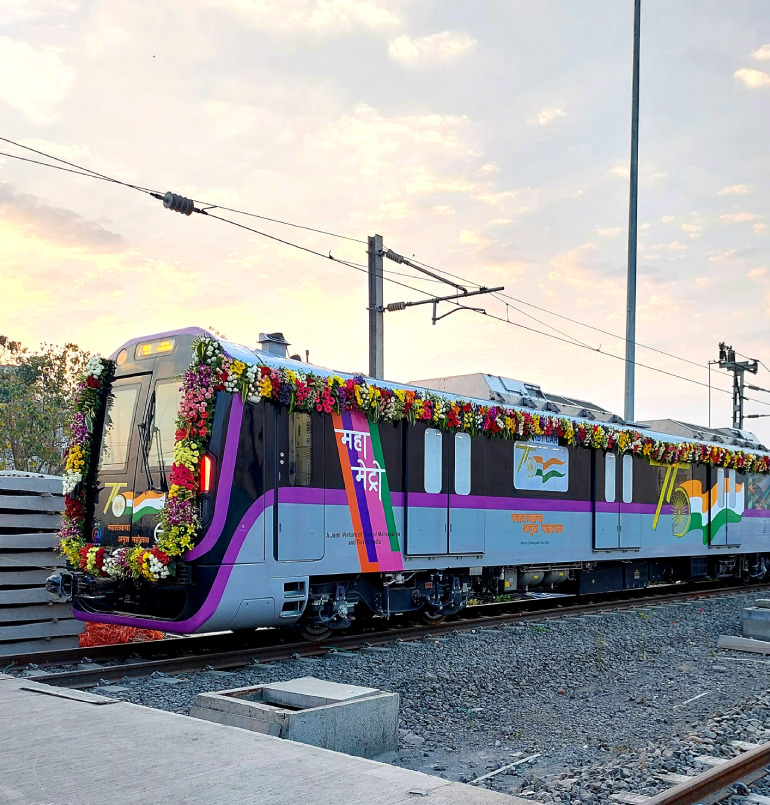
The Indian rail stock manufacturer Titagarh Rail Systems Ltd (TRSL) expects aluminium coaches to drive its next phase of growth, with FY27 and FY28 expected to mark a decisive ramp-up in the Passenger Rail Systems (PRS) business.
A key strategic initiative is the setting up of a dedicated aluminium coach manufacturing line, which is expected to be completed by Q2 of FY27, said Vice Chairman and Managing Director Umesh Chowdhary said during the company’s earnings call.
According to him, once operational, the facility will enable end-to-end production of aluminium metro coaches, from raw material and aluminium extrusions to finished car bodies and complete coaches.
Currently, the company imports flat packs and sub-assemblies from Europe and undertakes final assembly in India. The new line will ensure backward integration and significantly enhance value addition within the country.
The aluminium coach capability will also allow the company to manufacture car bodies for semi high-speed and high-speed trains, positioning it to participate in future investments under India’s expanding high-speed rail network.
Production of aluminium metro coaches for the Pune project will begin after the commissioning of the new line, with car body production likely to commence in Q3 or Q4 of the coming financial year, he said.
Parallelly, TRSL is developing a 1.6-km test track and strengthening backward integration of car body components.
Chowdhary described the test track as a game changer, especially for ambitions in the high-speed and bullet train segments. All these projects are targeted for completion in the first half of the next financial year.
Chowdhary noted that PRS, which accounts for over 75% of the standalone order book, recorded a sharp uptick in Q3. The real acceleration, however, will come over the next two financial years, driven by metro projects, aluminium coach manufacturing and Vande Bharat trains.
The company has committed around ₹1,000 crore in capital expenditure to build capacity for the projected scale-up in passenger rolling stock. The capex through FY27 will remain within this outlay and is being funded through a combination of equity raise, internal accruals and debt.
Production of Vande Bharat Express trains has already commenced. The company expects to complete the car bodies of the first 16-coach rake by March 2026, with the first fully assembled train likely to be ready in Q3 of the coming financial year.
On the freight side, revenue moderated from about ₹800 crore to ₹600 crore during the quarter, primarily due to wheel set-related issues that have since been resolved. Fresh railway orders in the first half of the next financial year are expected to support a recovery in the Freight Rail Systems segment.
Commenting on the Titagarh Firema SpA joint venture, he said the investment was originally driven by two strategic objectives — to establish a strong PRS base in India and to manufacture in Europe for the European market.
According to him, the first objective has been achieved with thumping success. The company today has a direct passenger segment order book of about ₹11,000 crore and an additional ₹7,000 crore through its joint venture with BHEL. This has delivered substantial returns and strengthened Titagarh’s position in India’s passenger rail ecosystem, he said.
However, the second objective — building a sustainable European manufacturing base — did not materialise as planned. The European operations continued to incur losses, and given the opportunities available in India and the challenging environment in Europe, the company decided against taking further exposure.
Chowdhary said Ferrovie dello Stato Italiane (Italian State Railways) has made an offer to buy out the company, and the transaction is currently under progress.
He clarified that the development will not impact Titagarh’s India operations, as the European business is no longer strategically synergistic with its domestic growth plans.