


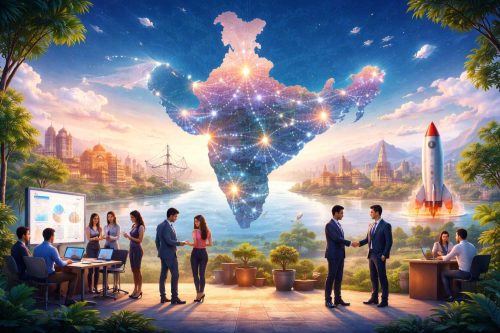
India’s start-up ecosystem has emerged as a major engine of employment generation, creating nearly 24-25 lakh jobs over the past decade as the number of start-ups in the country expanded from around 350-400 to nearly 2.3 lakh, according to Union Minister of State for Science & Technology and Earth Sciences Jitendra Singh.
Speaking at the RISE Conclave 2026 in Bengaluru, Singh said the rapid growth of the start-up landscape has positioned India as the world’s third-largest start-up ecosystem, underscoring the country’s transformation into a thriving innovation-driven economy.
Ecosystem drives employment and innovation
The minister said government-led initiatives have played a key role in creating a supportive environment for entrepreneurship, enabling India to leverage its demographic dividend and strengthen its position as a global innovation hub.
Highlighting the growing strength of the aerospace innovation ecosystem, Singh noted that mach33.aero, India’s first public-private aerospace incubation centre established by CSIR-NAL along with its partners, has completed five years of operations and supported 34 start-ups.
He added that more than 125 start-ups are participating in the RISE Conclave 2026, many of them operating in the aerospace sector, reflecting increasing interest among entrepreneurs in high-technology domains.
Aerospace sector gains momentum
Singh expressed confidence that collaborations between start-ups and scientific institutions would continue to generate employment and wealth while paving the way for the emergence of new unicorns in the coming years.
The minister said India’s innovation ecosystem is witnessing increasing participation from sectors that were traditionally underexplored. He pointed to the opening of the space sector to private players, which has delivered significant progress within a short period through policy reforms and industry participation.
He further noted that biotechnology, deep ocean exploration and nuclear energy are also attracting greater private sector involvement.
Tier-2 and Tier-3 cities emerge as innovation hubs
Referring to the changing geography of entrepreneurship in India, Singh said more than 50% of the country’s start-ups are now emerging from Tier-2 and Tier-3 cities.
According to him, this trend demonstrates that innovation is no longer concentrated in metropolitan centres and that entrepreneurship has become increasingly accessible to individuals with passion, commitment and technological capabilities, irrespective of their location or formal educational background.
India strengthens global innovation standing
The minister said India’s position in global innovation rankings has improved significantly over the last decade, supported by rising patent filings from Indian residents and growing recognition of Indian scientific research on the global stage.
He also highlighted progress under national initiatives focused on emerging technologies. Singh said the National Quantum Mission, launched with an eight-year roadmap, has already achieved several milestones ahead of schedule.
Similarly, he noted that the IndiaAI Mission is opening up fresh opportunities across computing infrastructure, data ecosystems, innovation and future-ready skill development, further strengthening India’s innovation-led growth trajectory