


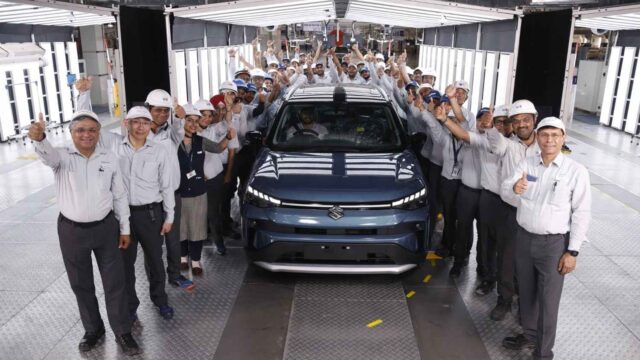
Maruti Suzuki India Ltd (MSIL) has inaugurated its state-of-the-art vehicle manufacturing facility at IMT Kharkhoda, Haryana, a project that will eventually become one of the world’s largest automobile manufacturing plants with an annual production capacity of one million vehicles.
The facility was inaugurated by Prime Minister Narendra Modi and Japan’s Prime Minister Sanae Takaichi during the India-Japan Joint Economic Forum in New Delhi, highlighting the deepening industrial partnership between the two countries.
The event was attended by Toshihiro Suzuki, Representative Director and President of Suzuki Motor Corporation (SMC), Hisashi Takeuchi, Managing Director & CEO of Maruti Suzuki India, and senior government officials.
₹35,000 crore investment to power future growth
The Kharkhoda facility forms a key pillar of Maruti Suzuki’s long-term expansion strategy. At full capacity, the plant will manufacture one million vehicles annually, contributing significantly to the company’s ambition of achieving four million units of annual production capacity across its manufacturing network.
Maruti Suzuki plans to invest ₹35,000 crore in the project, which is expected to generate more than 21,000 jobs.
Make in India driving global success
Suzuki Motor Corporation Representative Director & President Toshihiro Suzuki said the new facility reflects the success of the India-Japan partnership and the Government of India’s ‘Make in India’ initiative.
He said the Kharkhoda plant will be expanded from its current capacity of 500,000 vehicles to one million vehicles annually, making it one of the largest automobile manufacturing facilities globally.
Suzuki added that India’s importance within the Suzuki Group has increased significantly over the years.
He noted that the company’s first battery electric vehicle, the e VITARA, is being manufactured exclusively at Maruti Suzuki’s Gujarat plant for exports to 100 countries. He also said Suzuki has become the largest importer of passenger vehicles into Japan through exports of India-made cars, underscoring growing global confidence in India’s manufacturing capabilities.
Built as a Suzuki Smart Factory
The Kharkhoda plant has been developed as a Suzuki Smart Factory, integrating advanced digital technologies that enable real-time monitoring of manufacturing operations to improve safety, quality and productivity while reducing energy consumption.
The facility also incorporates Industry 5.0 manufacturing practices, including the deployment of Human-aware collaborative robots (COBOTS) that work alongside employees to enhance manufacturing precision and operational efficiency.
Powered entirely by renewable energy
Maruti Suzuki said 100% of the plant’s electricity requirements are currently being met through renewable energy sourced from a combination of solar power and green power procurement.
The facility presently has an installed 20 MWp solar power capacity, which is planned to increase to 70 MWp by 2030.
The company is also setting up a 10-tonne-per-day biogas plant and a 1 MWh Battery Energy Storage System (BESS) to further strengthen its clean energy infrastructure.
Zero liquid discharge facility
The Kharkhoda plant has been designed as a Zero Liquid Discharge (ZLD) facility, ensuring complete recycling of wastewater. Nearly two-thirds of the plant’s water requirement is met through recycled water and rainwater harvesting systems.
To improve logistics efficiency and reduce emissions from vehicle transportation, Maruti Suzuki will also establish an in-plant railway siding at the facility, similar to those operating at its manufacturing plants in Manesar, Haryana, and Hansalpur, Gujarat.
CSR and skill development initiatives
As part of its corporate social responsibility (CSR) programme, the company is implementing development projects across 10 villages surrounding the Kharkhoda facility. The initiatives cover education, healthcare, sanitation and community infrastructure in consultation with local communities.
Maruti Suzuki is also expanding its skill development efforts through four Japan-India Institutes for Manufacturing (JIMs) established in partnership with the Governments of India and Japan.
The institutes have trained around 2,600 students since inception, and the company plans to build student hostels at its JIM Sonipat and JIM Manesar campuses to support residential training.
The inauguration of the Kharkhoda facility marks one of Maruti Suzuki’s biggest manufacturing investments in India and reinforces its long-term commitment to expanding domestic production, boosting exports and supporting the country’s manufacturing-led growth