


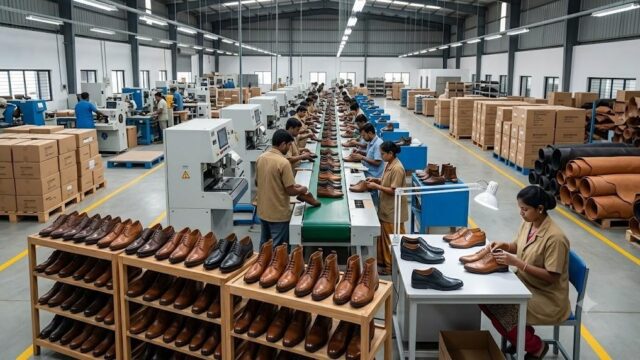
India’s leather and footwear industry is being urged to set its sights on becoming a $15-billion export sector, with the Centre arguing that recently concluded and upcoming free trade agreements (FTAs) have created an unprecedented opportunity to significantly expand the country’s global footprint.
Addressing the Council for Leather Exports National Export Excellence Awards for 2024-25, Union Commerce and Industry Minister Piyush Goyal called on the industry to target at least $15 billion in exports over the next five to six years, nearly three times the current export value of about $4-4.5 billion.
FTAs emerge as biggest growth catalyst
The government’s export roadmap is increasingly centred on leveraging FTAs to secure preferential market access for Indian manufacturers.
According to Goyal, India’s existing and upcoming trade agreements are opening doors to more than 60 countries, significantly expanding opportunities for leather and footwear exporters.
The India-UK FTA is scheduled to come into force on July 15, while negotiations with the European Union have entered the final legal review stage. Alongside agreements with ASEAN nations, Japan, South Korea and the UAE, India is also pursuing trade pacts with Canada, the Gulf Cooperation Council, Mexico, Brazil, the Southern African Customs Union (SACU), Israel and several Eurasian economies.
For the leather sector, these agreements could lower tariff barriers in premium markets where Indian products have traditionally faced pricing disadvantages.
Diversification seen as next growth imperative
One of the government’s key concerns is India’s heavy dependence on a limited number of export destinations. Currently, 77% of India’s leather exports are shipped to just 15 countries, exposing exporters to concentrated market risks. Goyal urged companies to expand into smaller developed markets, where consumers have higher purchasing power and demand for premium footwear and leather accessories continues to grow.
He also encouraged Indian companies to build their own designer brands rather than relying primarily on contract manufacturing.
Beyond footwear: A broader leather opportunity
While footwear remains the largest export category, the government believes the industry’s opportunity extends far beyond shoes.
Goyal highlighted products including handbags, wallets, jackets, belts, saddlery, furniture upholstery and luxury interior applications as high-value categories where Indian manufacturers can increase their presence.
“The sky is the limit when it comes to the potential of your industry,” he said while emphasising the sector’s wide range of applications.
Value addition to drive competitiveness
Rather than competing solely on costs, the minister urged the industry to move up the value chain through investments in product design and innovation, brand building, packaging and finishing, international quality standards, advanced testing infrastructure and large-scale manufacturing.
He said stronger branding and higher product quality would enable Indian exporters to capture better margins in developed markets.
Sustainability becoming a market differentiator
The Centre also sees sustainability emerging as a key competitive advantage for Indian exporters.
Goyal urged companies to adopt renewable energy, recycle water and industrial waste, improve effluent treatment and obtain sustainability certifications that are increasingly valued by international buyers.
He said products manufactured using renewable energy and sustainable practices are likely to command premium prices in global markets.
Technology to reshape the sector
The minister encouraged leather manufacturers to embrace robotics and artificial intelligence to improve precision manufacturing, demand forecasting and product design.
Contrary to concerns over automation, Goyal argued that technology-led productivity improvements would ultimately create more employment by expanding export opportunities.
The sector currently employs over 40 lakh people, and he said this workforce could potentially increase to one crore as exports expand.
Industry-led skill development
The government also proposed greater industry participation in managing leather development centres to improve workforce training.
Goyal suggested that large exporters either adopt existing centres or consolidate them into fewer, more efficient institutions. He also called for stronger collaboration with organisations such as the National Institute of Design (NID), the Indian Institute of Packaging, the Quality Council of India (QCI) and the Bureau of Indian Standards (BIS) to strengthen design, quality and product standards.