


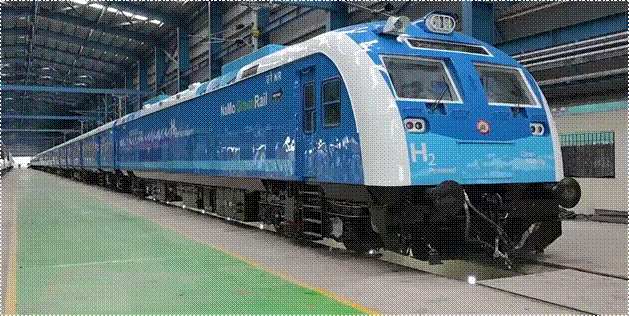
Indian Railways is set to usher in a new era of sustainable transportation with the rollout of India’s first hydrogen fuel cell-powered train, positioning the country among a select group of nations experimenting with hydrogen-powered passenger rail systems.
More than a technological milestone, the project represents the next phase of Indian Railways’ transformation from steam and diesel locomotives to cleaner energy solutions. After electrifying over 99% of its Broad Gauge network, the national transporter is now testing hydrogen as a zero-emission alternative for non-electrified and future rail operations.
A train that generates its own electricity
Unlike conventional electric trains that rely on overhead power lines, the hydrogen train produces electricity onboard through a Proton Exchange Membrane (PEM) fuel cell, where hydrogen combines with oxygen from the atmosphere to generate power.
The process emits only water vapour and heat, eliminating direct carbon emissions and combustion.
The 10-coach train comprises two Hydrogen Driving Power Cars and eight passenger coaches, with each power car generating 1,200 kW (1,600 hp). Together, they can propel the train at a design speed of 110 kmph, while initial operations will run at 75 kmph on the Jind-Sonipat route in Haryana.
Bigger than global hydrogen trains
While countries such as Germany, France, Italy, Japan and China have introduced pilot hydrogen trains, most operate with only two to four coaches on regional routes.
India’s version stands out with its 10-coach configuration capable of carrying around 2,600 passengers, making it one of the largest hydrogen-powered passenger trainsets developed globally.
Building a hydrogen ecosystem
The project extends beyond the train itself. Indian Railways has established India’s largest railway hydrogen refuelling facility at Jind, creating a complete hydrogen ecosystem that includes hydrogen production through electrolysis, storage, compression and dispensing infrastructure.
The facility can store nearly 3,000 kg of hydrogen, compress it to 500 bar, and dispense fuel at 350 bar to both power cars simultaneously, reducing turnaround time.
The hydrogen storage and supply infrastructure has received approval from the Petroleum and Explosives Safety Organisation (PESO).
Safety takes centre stage
Given hydrogen’s highly flammable nature, Indian Railways has adopted a multi-layered safety architecture based on globally accepted “defence in depth” principles.
The train is equipped with continuous hydrogen leak detectors, flame and smoke sensors, heat monitoring systems, automatic shutdown mechanisms and advanced ventilation systems that immediately disperse any leaked hydrogen.
The hydrogen ecosystem has also undergone an independent safety assessment by TÜV SÜD, Germany, while complying with international standards including NFPA-2 and the ISO 19880 Series. The train was subjected to extensive testing covering electrical systems, braking, oscillation stability and radio frequency compatibility before being cleared for operations.
Indigenous technology, global ambition
The hydrogen train has been designed and integrated largely using indigenous capabilities.
The Research Designs and Standards Organisation (RDSO) developed the technical specifications, Medha Servo Drives integrated the trainset, while the Integral Coach Factory (ICF) contributed to its design.
Indian Railways is also evaluating the deployment of hydrogen technology on heritage routes, including the Kalka-Shimla Railway, signalling its intent to expand hydrogen-powered rail operations beyond pilot projects.
As India pursues its net-zero ambitions, the hydrogen train represents more than an engineering achievement. It demonstrates how clean technologies, indigenous manufacturing and modern infrastructure can converge to create the next generation of sustainable public transport.