


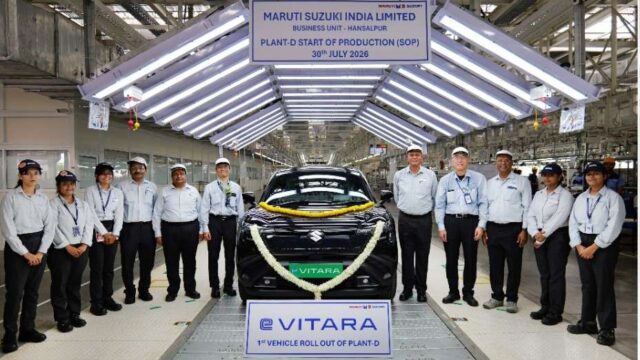
Maruti Suzuki India Ltd has crossed a historic manufacturing milestone by commencing commercial production at the fourth plant of its Hansalpur facility in Gujarat, taking the complex’s annual production capacity to 1 million passenger vehicles—the first time any Suzuki manufacturing site worldwide has achieved the feat.
The expansion also makes Hansalpur India’s largest passenger vehicle manufacturing facility at a single location, underscoring Maruti Suzuki’s strategy of scaling production to meet rising domestic demand while strengthening India’s position as a global export base.
With the commissioning of Plant D, which has an annual production capacity of 250,000 units, the Hansalpur complex’s capacity has increased from 750,000 units to 1 million units. Maruti Suzuki’s total manufacturing capacity across India has now reached 2.9 million units annually.
EV production begins
The newly commissioned plant has been built with an estimated investment of ₹3,900 crore, taking Maruti Suzuki’s cumulative investment in the Hansalpur facility to ₹25,288.7 crore.
The plant will initially manufacture the company’s flagship battery electric vehicle (BEV), the e VITARA, highlighting the strategic role Gujarat will play in Maruti Suzuki’s electrification roadmap.
Hansalpur already manufactures popular models including the FRONX, Baleno and Swift, and has evolved into a key export hub, accounting for nearly 47% of the company’s overseas shipments in FY26.
Gujarat emerges as manufacturing powerhouse
The milestone reflects Gujarat’s growing importance in Maruti Suzuki’s long-term manufacturing strategy.
Maruti Suzuki India Ltd Managing Director & CEO Hisashi Takeuchi said Gujarat has evolved into a manufacturing and export hub for the company, supported by strong infrastructure and a progressive industrial ecosystem.
He said the commissioning of the fourth plant enhances Hansalpur’s annual capacity to one million vehicles, enabling the company to meet growing demand in India and overseas while advancing its “Make in India, Make for the World” strategy.
Takeuchi added that the Hansalpur facility, together with the upcoming Sanand plant, would be central to the company’s ambition of achieving 4 million units of annual production in India.
Beyond capacity expansion
The latest investment is significant for more than its scale. It reflects Maruti Suzuki’s effort to build an integrated manufacturing ecosystem spanning electric vehicles, exports, green logistics and skill development.
The company has already introduced India’s first automobile in-plant railway siding at Hansalpur under the PM GatiShakti programme. Since rail dispatches began, Maruti Suzuki has transported over 750,000 vehicles, helping reduce logistics-related carbon emissions, fuel consumption and road congestion.
In another sustainability milestone, the Gujarat railway logistics project became the world’s first modal shift transportation project to be registered under Verra’s Verified Carbon Standard (VCS) in February 2026.
Building future talent
Alongside manufacturing investments, Maruti Suzuki has expanded its skill development initiatives in Gujarat through Japan-India Institutes for Manufacturing, Advanced Manufacturing Labs across Industrial Training Institutes, Automobile Skill Enhancement Centres and the International Automobile Centre of Excellence at Gandhinagar.
These initiatives are aimed at creating a steady pipeline of industry-ready talent to support the company’s future manufacturing expansion and India’s transition towards advanced and electric mobility.