


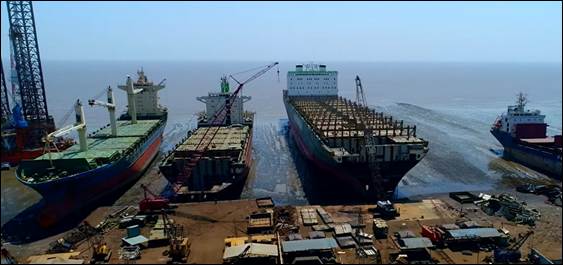
India has emerged as the world’s leading ship recycling nation, with its share of the global market rising to 35.4% in 2025 from 30.1% a year earlier, as recycling volumes surged nearly 60% to 2.99 million Gross Tonnes (GT).
According to the latest report of the United Nations Conference on Trade and Development (UNCTAD), India’s ship recycling volume increased from 1.86 million GT in 2024 to 2.99 million GT in 2025.
The achievement marks the fulfilment, five years ahead of schedule, of the target set under Maritime India Vision (MIV) 2030 for India to become the world’s leading ship recycling nation.
India’s ship recycling industry has undergone a significant transformation in recent years, moving from conventional dismantling practices towards a more regulated, environmentally sound and internationally aligned industry.
Alang remains the backbone
The Alang-Sosiya ship recycling cluster in Gujarat remains the backbone of India’s ship recycling capacity and accounts for approximately 98% of the country’s ship recycling activity.
Recognised as the world’s largest ship recycling hub, Alang has an annual recycling capacity of around 6 million GT and produces approximately 3.50 million metric tonnes of steel a year without exploiting natural resources.
The cluster is supported by authorised ship recycling yards, downstream steel re-rolling mills and waste management infrastructure.
India now plans to nearly double its ship recycling capacity to about 9 million light displacement tons (LDT) through the planned development of the Alang Ship Recycling Yard.
A comprehensive master plan has been prepared to improve infrastructure and strengthen the competitiveness of the cluster as global demand for responsible ship recycling grows.
The Safety Training and Labour Welfare Institute at Alang-Sosiya has cumulatively trained more than 1.5 lakh workers in occupational safety, hazardous material handling and emergency response.
India also has ship recycling facilities at Amar Iron Udyog in Kolkata and Steel Industrials Kerala Limited (SILK) in Kerala.
From dismantling to circular economy
Ship recycling has become an important component of the maritime lifecycle, enabling ships at the end of their operational life to be dismantled in a safe and environmentally responsible manner.
The sector also contributes to India’s circular economy by recovering steel and other reusable materials.
Recycled steel requires substantially less energy than primary steel production and can result in lower greenhouse gas emissions, supporting India’s sustainability and decarbonisation objectives.
For the domestic steel industry, ship recycling provides a significant source of ferrous scrap, helping reduce dependence on imported raw materials and strengthening resource security.
Economic impact
The industry also supports large-scale employment across dismantling, processing and material recovery activities.
Its economic footprint extends to a network of ancillary industries, including transportation, re-rolling mills, equipment suppliers and waste management services.
Recovered steel and reusable components feed into domestic manufacturing and industrial production, supporting initiatives such as Make in India and Atmanirbhar Bharat.
Regulation strengthens global standing
India’s emergence as a leading ship recycling destination has been supported by stronger legislation, institutional oversight and modernisation of recycling yards.
The Ship Recycling Act, 2019 provides the primary legal framework for regulating ship recycling and gives domestic effect to international standards. It also designates the Directorate General of Shipping as the National Authority and provides for authorisation, certification, inspection and enforcement.
The Ship Recycling Rules, 2021 operationalise the Act by prescribing requirements covering facility authorisation, ship recycling plans, hazardous material management, worker safety, training and reporting.
The Ship Recycling Regulations, 2026 further strengthen implementation through detailed operational, safety and environmental standards, supporting uniform compliance and monitoring across ship recycling facilities.
India’s framework is aligned with international conventions and global best practices, including the Hong Kong International Convention, reinforcing the country’s position in the global ship recycling market.
Modernising the yards
Indian ship recycling yards have also undergone extensive upgrades, with engineered and demarcated recycling plots, impermeable working surfaces, drainage systems, mechanised material-handling equipment and segregated hazardous-waste storage facilities.
Authorised downstream waste treatment and disposal linkages, along with structured safety, health and emergency-response arrangements, have further strengthened operational efficiency and environmental compliance.
With rising recycling volumes, modernised infrastructure and a stronger regulatory framework, India is positioning ship recycling not merely as an end-of-life activity but as an important part of its maritime, industrial and circular-economy ecosystem.